
The marten, the sole marten of South India, is out there, alive, somewhere in the shola mist. We know so little about it, and that’s another part of the problem.
Some animals have loud deaths: their decline noted, debated, televised. Scientists follow them with radio collars, governments frame policy around them, and children know their names. Others have deaths that will pass almost unnoticed. The Nilgiri marten appears to be such a case. It lives in one of the most biodiverse parts of the world. It’s endemic to India: nowhere else on earth. It is the sole marten species for the entirety of India south of the Himalayas. It has an estimated population of one thousand: rarer than many more protected animals. And yet it spent the better part of the twentieth century and much of the twenty-first virtually unstudied – glimpsed briefly in high altitude forests, caught on film occasionally by remote cameras, written up in chance field notes of the many naturalists who were often surprised by their appearance. Such invisibility has negative consequences: an animal that cannot be studied cannot be saved. And the marten is running out of time.
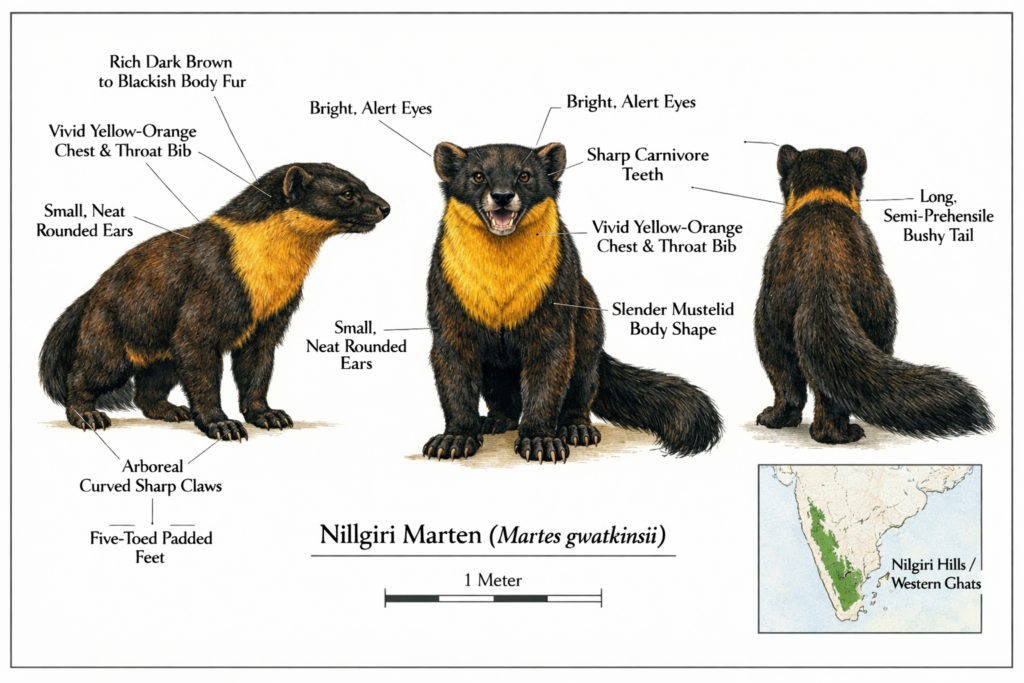
An animal in its environment :
The Nilgiri marten – Martes gwatkinsii, named after one Reynolds Gwatkins, collector of this skin for the East India Company’s museum – is in the family Mustelidae, one of the most successful and adaptable carnivore families in the world. Otters, stoats, badgers, wolverines and weasels all belong to this group. One of the more dashing members of the family, Martes are fast-moving, semi-arboreal, sharp-clawed, sharp-minded, and possessed of a somewhat frantic energetic quality that makes them fun to watch.
The Nilgiri marten is the southernmost of the eight species of marten in the world, and the only one to inhabit tropical India. Its closest relative – or at least, the species earlier identified as closest – is the yellow-throated marten, Martes flavigula, found throughout East and Southeast Asia. It is a little bigger than its eastern counterpart; different in skull construction, but marked by a brightly-colored throat-patch, varying in hue from pale yellow to rich, almost luminous orange. The rest of its body is a deep, glossy brown on the shoulders and head, tending towards russet on the front of the body. It’s an attractive animal, whatever way you cut it.
It’s not large. The body measures 55 to 65 cm (21.5-25.5 in) from the nose to the rump, with the tail being another 40 to 45 cm (16-17.5 in) – so more or less again. The animal weighs 2.1 kg (4.6 lb), and is light enough that it should be able to scramble through the trees with a skill ground-dwelling animals can only watch with envy. While it will come to ground-especially to hunt-the marten is quite emphatically a creature of the trees.
How little we know:
It’s not what we know about the Nilgiri marten that’s most startling, it’s what we don’t know. The lack of information on a species known to science since 1851 is remarkable, given what we do know of the basic animal. Most of the 20th century records of this species amount to an occasional sighting – one naturalist sighting six in the Nilgiri Biosphere Reserve over two years; another a hunting attempt at Periyar Tiger Reserve; another a field worker spotting one single observation in Karnataka. Such sightings were the result of chance and the luck of being in the right place at the right time in the right forest; systematic surveys, or in-depth studies were absent. In addition, this is a diurnal species; its activity during daylight hours would make it seemingly easier to monitor than many nocturnal animals but its movements are fast and it occupies a dense habitat where visibility is often limited. Camera traps have supplemented the few existing observations but, by and large, well-targeted surveys-systematic, standardized field work that generates statistics-have been absent. As is stated in the introduction to the publication which is the basis of this summary, most published sightings of the Nilgiri marten are ‘opportunistic’: just that. With so little to base an estimate on, the population of one thousand is rough at best. Furthermore, information regarding home range size, breeding ecology, population dispersal or mortality are unknown. We know it is omnivorous, feeding on small mammals including the Malabar giant squirrel and small birds; and also insects and, to a lesser extent, fruits and nuts, but the particulars of its hunting technique, feeding habits and seasonality are incompletely researched. While it uses tree hollows as dens and as shelter for sleep and rest, and such cavities appear more prevalent in mature, old trees (some of which are IUCN Red Listed species), how much suitable habitat remains and how rapidly that is disappearing is also unconfirmed.
The Shola World and Why It Matters :
If you are to understand the habitat requirements of the Nilgiri marten you need to know what the shola forest system is; what a unique phenomenon it is, and more pressingly, what a fragile one.
A shola is not a forest in the usual sense of the term. It is a montage evergreen forest confined to areas over about 1500 metres in the southern Western Ghats, nestled in the higher cooler and wetter reaches of Kerala, Tamil Nadu and Karnataka. They never form continuous forests, but consist of island patches of dense mist shrouded forests tucked in folds of topography, ringed by the open montane grassland habitat. The effect is one of contrast-stepping from a shola into the grassland is one world from another. The temperature rises the mist thins out, suddenly you can see the landscape rolling for miles.
The shola-grassland system is not simply a result of topography. It is an ancient system with its own internal logic which has evolved over millennia of climate, fire and grazing. The animal community living within is highly specialized. The shola-grassland system in the Nilgiris and surrounding ranges supports a remarkable level of endemism – the Nilgiri tahr, Nilgiri langur, the lion-tailed macaque, a number of bird species endemic to that ecosystem alone. The Nilgiri marten is just one part of that ecological web – a predator adapted to precisely this unique environmental context.
The problem is that the system is declining and fragmenting faster than it can cope.
The large scale conversion of the shola forest ecosystem into tea and coffee plantations was initiated by the British during the colonial era in the mid-nineteenth century and continued throughout the twentieth century. The Nilgiri hills, forming the epicenter of the martens distribution have been extensively converted to tea estates. The continuous shola forests fragmented into dispersed plantation and the original shola system into isolated forest patches. The original Sholas were now fragmented and isolated; hemmed in on all sides by vast monocultures.
The data about the crisis :
A 2023 paper published in the journal Mammalia gives the most systematic picture to date of Nilgiri marten’s habitat problems and the data it provides is grim. Applying a modeling process called Maxent, the lead author T.T. Shameer and colleagues estimate the total potential habitat niche for the Nilgiri marten in the Western Ghats to be around 8,922 km². It’s a big area. But the way that space is parcelled out is another matter altogether. 38% (about 3,353 km²) falls within legally protected areas; the other 62% is categorized as multi-use land, comprised of tea estates, coffee plantations, timber plantations and mixed agricultural and forestry land use. The presence of the marten in some of these areas is encouraging-martens have been found to have some tolerance for human-altered landscapes elsewhere, and there have been documented sightings in cardamom and coffee plantations-but “presence” doesn’t mean “thriving”. Multi-use lands have no protection, are readily converted to other land use without advance warning and are subject to human disturbance-foot traffic, pesticides, hunting pressure-which the marten isn’t very good at coping with. Even more troubling, over the previous 20 years the forests in the potential habitat had lost about 94 km² of cover, a number that the current population has no meaningful timeframe to recuperate: Shola forests don’t regenerate easily, their trees grow slowly, it takes decades for canopies to close, and it takes even longer for their complex understory ecology-mosses, epiphytes, invertebrate communities which the marten’s prey rely on-to rebuild, assuming the canopy returns at all. While the paper did for the first time record the presence of the species in the upper portions of Mudumalai Tiger Reserve (expanding the known range and hinting the species is a bit more widespread than previously assumed), finding a species in a new place doesn’t prove it’s a healthy population. It just proves it has turned up there on occasion.
A Creature Isolated on Sky Islands :
There is a term used in ecology “sky island”-first applied to isolated mountains ranges in the American Southwest, in which the high-elevation communities are separated from one another by canyons impassable to cross them; and as such, these mountains stand as biological islands on the ocean of the unsuitable habitat that surround them. The high-elevation forests of the southern Western Ghats behave in exactly the same manner.
The Nilgiri hills, Anamalai hills, Palani hills, Agasthyamalai massif – each one of these high ranges have a characteristic community of forest-dwelling creatures that do not inhabit lower ranges and, most important, are many endemic. The marten lives on a few of these massifs, but its passage among these communities-over agricultural or deforested land that lies between-is minimal, and it only diminishes in extent as the landscape in between is converted to unsuitable land use (i.e. Roads, tea estates, villages, scrub). The marten’s ability to pass over these barriers is and extent to which it can pass-or does pass-over them is not known.
What is known from the studies of species with the same ecological role in similar contexts is that this kind of landscape fragmentation has very specific genetic implications. Small populations will not exchange individuals; therefore they cannot exchange genes. The genetic variation within each of the small sub-populations dwindles. Genetic diversity leads to reduced fitness, lower reproductive rates, disease and environmental vulnerability, or even an increase in depression. Even if there are a thousand creatures spread across the landscape in isolated segments of forest, each group represents an ongoing small-scale extinction.
Tree cavities have also shown a similar picture of this kind of fragmentation. In tree hollow use, the Nilgiri marten tends to use large, mature old-growth trees with natural cavities for shelter and, presumably, breeding sites. Trees with average height of about 27 meters and an average circumference of greater than 3 meters-that are typical for species with natural cavities-are rare, and these trees reflect an older structure in the forest; as of that, many of the species of trees identified with use of cavities by the Nilgiri marten in the tree hollow use research are on the IUCN red list.
How the Marten Contributes to the Forest :
We could easily tell a story where it is the Marten that benefits from the forest. But the relationship is more complicated than that and the Marten is by no means a passive recipient.
As a predator in the middle of the food chain, the Nilgiri Marten helps keep the population sizes of the creatures it feeds on, in check. Birds, rodents, insects, squirrels-all are kept under a certain pressure and this pressure cascades throughout the habitat, influencing plant structure, dispersal of seed, and predator-prey relationships among various other creatures in the ecosystem. Let the Marten out of the picture and a force maintaining equilibrium vanishes. Prey populations increase; they start competing with each other. Vegetation responds. These impacts radiate through the system in often unexplainable ways and even more difficult to undo.
Scientists have known for a long time in North America and Scandinavia the Marten is what scientists term as an ‘umbrella species,’ an animal that when managed so that it can survive on the landscape automatically guarantees the survival of numerous other animal species that occupy the same habitat. The reason why the Matesen is believed to function this way is because its ecological requirements for the Marten, old-growth structure and low disturbance levels, is likely identical to what most other species living in the habitat also needs. So in taking steps to conserve the Marten, you in fact, conserve other animals as well.
This concept has not been widely utilized in India because we do not know enough about the Marten to use it as an indicator of management success. Nevertheless the logic still holds that the requirements of the Marten, vast contiguous tracts of evergreen high elevation shola forests with old growth, low levels of human disturbance and rich prey communities, are exactly the same as the requirements of the shola habitat itself. So it is not a limited target species approach but rather an entire ecosystem’s benefit we are trying to achieve through the conservation of the Marten.
Protected areas: A necessity, but not a cure
Nilgiri Marten ranges in or around a few large protected areas. Not Dachigam, but among the habitat fragments the Marten uses, there really are some truly important conservation areas: The Nilgiri Biosphere Reserve, Silent Valley National Park, Parambikulam Tiger Reserve, Eravikulam National Park, Indira Gandhi Wildlife Sanctuary, Mudumalai Tiger Reserve, Mukuruthi National Park and the Neyyar and Peppara Wildlife Sanctuaries in Kerala. This is quite a conservation structure in the southern Western Ghats.
But the study from 2023 brings out the limitations of this structure. Only 38% of the niche modelled for Martens was covered by protected areas. The ecological niche, cold and wet montane, simply did not line up neatly with boundaries placed around some places to conserve them. The habitat spills onto plantations, onto reserve forest areas with no specific wildlife protection status, onto the buffer and corridors between some national parks. How do you protect an animal that uses connected forest across a mountain range using nothing but a collection of isolated reserves, even if each reserve itself is expertly managed.
The Nilgiri Biosphere Reserve was created as a landscape-level approach, a matrix which contained a central zone and buffered areas, transition zones with human use, all acting as a gradient from absolute protection to Managed cohabitation. A biosphere reserve ideally represents the kind of scheme the Nilgiri Marten requires. In reality, the Indian biosphere reserve concept has generally lacked adequate enforcement capacity, faced coordination challenges between various state government agencies and peoples interests and the goals of conservation efforts with their economic consequences on people who use and reside in and around these reserves.
As a specific priority it was found researchers needed to formally protect parts of reserve forest adjacent to current national parks, in the marten’s range particularly unprotected areas at higher altitudes. Classifying such forest lands as wildlife sanctuaries or extending existing national parks boundaries, wherever ecologically and socially feasible would provide additional protected areas for this animal.
What could actually work?
The mystery is not in knowing what the Nilgiri marten needs (at a basic level). The mystery is in why the knowing-doing gap remains so enormous.
Sustained, adequately funded research is the first priority. You can’t manage a species well if you barely know anything about it. Camera trapping networks, genetic studies, diet analysis, occupancy modeling, these things don’t cost an enormous amount in the overall context of India’s conservation budgets; they just lack priority, focus, and the institutional continuity that enables long-term monitoring.
Extending legal protection to non-protected reserve forest lands within and immediately adjacent to the marten’s range would place additional habitat under a conservation management regime, with relative ease. This is a regulatory action rather than an investment.
Working with the tea and coffee plantation companies, who own 62 percent of the marten’s habitat, to incorporate wildlife-friendly practices such as native shade trees, preservation of old hollow trees, and native canopy corridors between forest patches, would draw this habitat into the conservation sphere. This is economically complicated, but in some areas market incentives, such as shade-grown or wildlife-friendly certifications, are becoming a force for good, and the plantation sector in the Western Ghats is large enough for even limited adoption to make a difference.
Managing invasive species, particularly wattle and eucalyptus, in areas adjacent to shola cores, would slow down marginal habitat degradation, and potentially even restore connectivity between patches. This requires labor, but is the kind of ecological management that India’s CAMPA and forest restoration schemes, at least on paper, are supposed to be for.
And, most significantly, raise the profile of the species. The Nilgiri marten can never be a tiger; it is unlikely to ever garner the same degree of public or political attention or effort. However, it can represent what the tiger (ironically) cannot: the status of an entire ecosystem. A viable Nilgiri marten population would suggest healthy shola, that in turn, supports everything else that needs to be present. Framing it as an indicator species could imbue it with the conservation salience it currently lacks.
A glimpse in the fog :
In a Nilgiri morning, when the mist still lies low in the valley, and the temperatures still fail to break the double digits, the shola appears perfectly unconcerned with humanity. It is damp. The light filtering through is green and diffuse. Somewhere, in the mid distance, a bird lets out a call, something indigenous, and nowhere else on earth.
And high in an old, large subcanopy tree, below the ten meter mark, a Nilgiri marten might be denning. Or moving through the branches with marten fluency. Or hunting-stopping, watching a branch, and then leaping toward a squirrel with an instantaneous speed that is somehow impossible to believe considering the stillness before.
A thousand such moments as that occur every year. A thousand such animals living in a fragmenting forest. A thousand such individuals living in sub-populations whose connections to one another are stretching thin. A thousand animals whose biology and ecology still remain (after 170 years of supposed familiarity with humans) quite largely unexamined.
That number, a thousand, is nothing like catastrophically small, in the same way that 150 hangul deer are. But the Vulnerable status; 62 percent of remaining habitat is undefended; 94 km 2 lost in 20 years; the complete lack of systematic population monitoring; these taken together make for a narrative of a species which, though not currently in freefall, seems nevertheless to be on borrowed time, and at a species level seems to be living on borrowed time in a landscape where debts are mounting at a rate far in excess of anyone’s ability to pay.
The Nilgiri marten has not resigned itself to abandoning its home. It lives in the mist, still, it moves through the shola, it denns in the trees. It can survive its habitat- it evolved over eons. What it cannot necessarily survive is ours.