
The Hangul Deer Kashmir’s last red stag is running out of time – and out of forest. There is a valley in the Himalayas, where if you get up before the sun, and steal up into the tree line above Srinagar, you can sometimes still hear something primeval – the bugling cry of a stag echoing off the Zabarwan mountains. A sound that has, for hundreds of thousands of years, resonated in this landscape. It is a sound which the creature responsible, the hangul, Kashmir’s emblematic red deer, may soon be making for the last time. There are, to the most recent reliable estimates, between 150 and 323 hangul left in the wild. Nobody is exactly sure where within that range it lies. Some surveys are more optimistic than others, some more bleak, but all are certain of one thing: the hangul are precariously close to slipping from the planet forever. It is, here, that story: of how a deer that once grazed in thousands, became one of the continent’s most endangered large mammals, and how they might, one day, be saved.
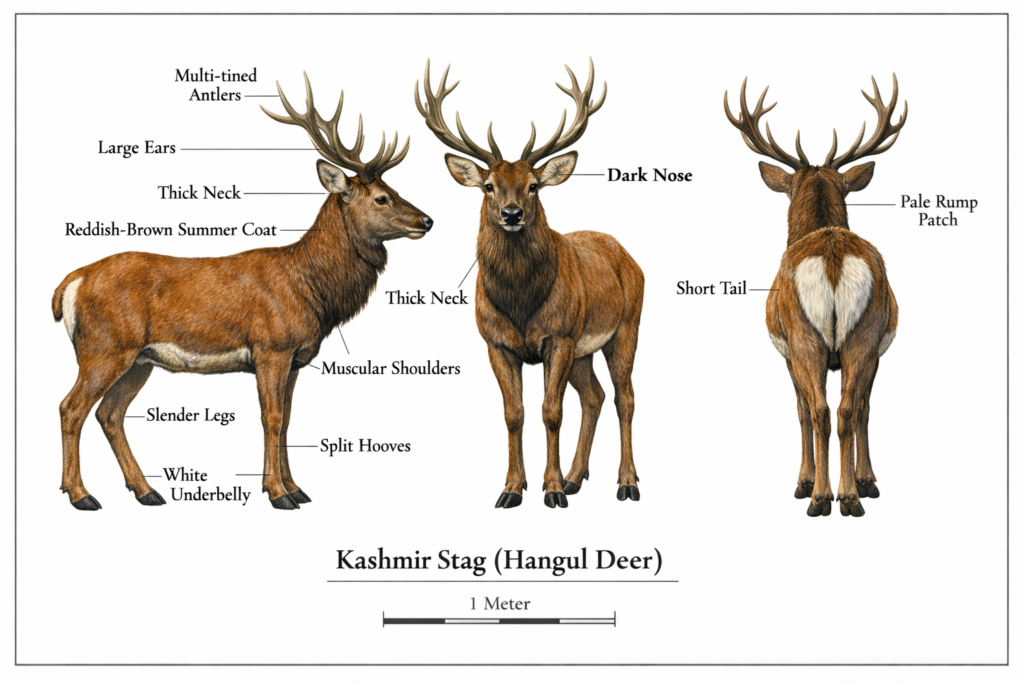
What is The Hangul ?
Known also as the Kashmir stag, the hangul, Cervus hanglu hanglu, is a subspecies of the Central Asian red deer, although referring to it as a “red deer” actually understates what it is. It is the last surviving Asian representative of the entire red deer complex that exists within the Indian subcontinent. Its relatives occurred throughout the eastern Himalayas and Central Asian highlands in a broad arc but have long since disappeared one by one. The Sikkim stag, sometimes known as the Shou, had long gone from the eastern Himalayas and only the hangul is left.
The animal itself is interesting, as far as genetics go. A recent mitogenomic study has confirmed the hangul to be part of the Tarim red deer complex that split off from its nearest relatives about 750,000 years ago, coincident with large scale glaciation in Central Asia. In other words, the hangul is not a local subspecies; it is a distinct lineage that has adapted to the pressure of the Himalayas over millions of years.
A hangul is visually distinctive as anyone who has seen one will note. It sports a stunning, sprawling, branching antler structure that most frequently boasts 11 to 16 points. Hunters have historically coveted these magnificent crowns and they remain valuable items on the black market, used in traditional Asian medicines. The animal is warm brown in color and a shaggier winter coat is produced. It has a distinctive pale rump patch that flashes conspicuously when the animal takes to flight. The males are more than twice the weight of the females and grow quite aggressive in the autumn rut, with stags engaging in pushing matches and challenging each other to vocal duels across the valleys in their quest for supremacy.
If you’re not acquainted with the scale of disaster here, you’ll have to understand just how plentiful hangul once were. In the 1940s, the population was estimated by naturalists and hunters as ranging between three and five thousand animals. They ranged over vast tracts of land in Kashmir, dipping into the northern regions of Himachal Pradesh’s Chamba district. Great herds were common on the high meadows and on the thickly wooded riverine forests below. One forest guard, Ghulam Ahmad Bhat, who has worked in Dachigam National Park for decades, following in the footsteps of his father who did the same, will still speak of the great herds he used to see constantly when he first came to work. That is a different era.
By the 1970s, the number of animals had plummeted to around 150. The reasons were not mysterious: habitat destruction through clearing of forests; overgrazing by livestock in meadows relied on by hangul; and heavy hunting (for trophies, and for parts sought in wildlife markets). The Indian government, the IUCN, and WWF launched a project: the “Project Hangul”, in 1970. It was so significant that it worked – for a time. By 1980, numbers were up over 340. Dachigam National Park, situated on the foothills of the Zabarwan range just outside Srinagar, was given greater attention and protection. For a brief window in the early 1980s, it was named India’s best-managed national park. For a fleeting time, hopes were raised cautiously.
Then they were lowered again. The numbers stabilized, then waivered, in some years plunging sharply. A 2004 count found only 197 animals. That number dropped further to 153 in 2006. A 2015 survey seemed the bleakest: estimations for the Dachigam park alone placed hangul at between 110 and 130, the lowest count yet. The overall Kashmir number at the time was estimated between 150 and 180. More recent surveys are showing marginal, and fragile, improvement; a 2019 count put the number at 237; the 2023 estimate at 289. And the 2025 count reached 323 – just about double the 2004 number of 197 spread out over two decades plus work. These increases are cautious numbers for conservationists. As researchers writing for the 2023 journal Oryx noted, the hangul population “ may be in a terminal phase of decline and could become extinct if effective interventions are not implemented.”
The last bastion of hangul. Today the hangul survive on largely one patch of ground – the Dachigam National Park; 141 square kilometres of steep, forested country in the foothills of Srinagar. A few individuals exist in other areas near here – the Rajparian Wildlife Sanctuary; some of the Overa-Aru landscape; the Sind Valley; and in the forests near Kishtwar and Bhaderwah-but Dachigam is the last bastion of significance. The terrain within the park is dramatic. In the lower reaches are rivers and valley floors thick with trees-riverine forest of willows, alders and maples, and the water courses are cold and clear; further up and the slopes become steep, and rise through alpine meadows to rocky, snow covered peaks. The hangul move through the park with the seasons, moving to the higher meadows during summer where they feed on lush grass, and returning to the lower reaches as winter descends. During the rut, in late autumn when the animals return down the slopes, bugling stags compete vigorously with their rivals; locking antlers and throwing all their body weight at each other to drive others from the harem. Stags accumulate considerable harems, and the spectacle of a few rutting stags with their harems on show is spectacular-a sight you’d never forget if you were lucky enough to see it. But the spectacle now involves a few animals and increasingly few displays, with the meadows and pastures being increasingly shared with livestock, shepherd camps, army posts and the everyday presence of man.
The Threats: A Perfect Storm
If you wanted to design a scenario that would drive a large mammal to extinction, you would come up with something that looks strikingly similar to the hangul’s current predicament. Multiple threats interlink, synergize and amplify each other.
The problem of poaching, despite strict legal protection, is a persistent threat. The hangul is classified under schedule I of the Wildlife (Protection) Act of 1972, the most protected species in the Indian lexicon, and is listed in Appendix I of CITES. Nevertheless, there is a continued demand on the black market for antlers, velvet, and body parts that lures poachers into the park. Indeed the current severe disproportion between male and female hangul has been attributed, at least in part, to the fact that it is the males that are predominantly hunted and killed, because their antlers fetch a high price.
Predation also compounds the issue; Common leopards and Himalayan black bears both hunt fawns, leading to worryingly high fawn mortalities. Healthy populations can cope with predation pressure, but for a population of this size, each fawn that is lost contributes to a critically endangered breeding structure. The fawn to female ratio-the most important indicator of the reproductive health of a deer population-was recorded as being as low as 14 fawns to 100 females within Dachigam, and as low as 6 per 100 outside the park. For comparison, a healthy population of European red deer might have a fawn ratio of over 30 per 100 females.
Free ranging dogs are an often overlooked but significant threat. Semi-feral and stray dogs associated with human settlements surrounding the park will chase and disturb the hangul, particularly during the crucial calving period. One 19 year study on the hangul recommended that controlling free-ranging dog populations should be one of the primary interventions to save the hangul population.
Political instability is another layer that complicates matters. Ongoing conflicts in Kashmir can lead to disruption of conservation work and make field work difficult.
The Genetics Problem :
Even with the elimination of all the aforementioned problems, there is a quieter crisis unfolding within the hangul population. This problem can’t just be resolved by keeping livestock out of the grazing areas or stopping poachers.
This critically endangered population has shrunk to below 300 individuals and therefore is beginning to suffer from inbreeding, and the number of individuals contributing genes to the population is also dwindling. Latest studies show that the Dachigam population’s heterozygosity is currently similar to some “Least Concern” European red deer populations, which sounds good until one considers what this really means in the context of this situation. Those European red deer populations are enormous, widespread animals, but they benefit from these large numbers and the geographic spread, which allow the deer to interbreed. The hangul lacks these things.
The genetics problem is exacerbated by the skewed sex ratio. The enormous lack of males to females (in one study 23 males to 100 females), means the effective breeding population size is significantly smaller than the number that suggests, so that loss of just one animal has a much greater effect on loss of genetic variability than in normal situations.
A population viability analysis suggests the hangul can be saved with intensive protection but also warned, along with the 2023 Oryx paper, that unless it is carefully managed the population is vulnerable to being trapped in what ecologists call the ‘extinction vortex’. This ‘extinction vortex’ is a phenomenon in which an ‘inbreeding depression and loss of genetic variability reduce the reproductive fitness of the population, further increasing the extinction risk and promoting a vicious cycle of decline’30; and which perfectly describes the current condition of the hangul population.
The People Who Live With The Hangul :
No discussion of the hangul situation would be complete without an acknowledgement of the people who have lived alongside the animal and its surroundings for centuries.
The Bakarwal and Gujjar communities, nomadic herders who have driven their livestock through Kashmir’s high pastures for centuries, transit the essential high meadows in their seasonal migration routes in the summer, exactly the territory the hangul relies upon. There is not inherently a conflict between people and deer; people and deer shared the mountains for millennia. The problem is that the deer population has shrunk so drastically that even this historic coexistence is not sustainable for the species.
Local communities have occasionally been considered impediments to conservation, rather than potential partners, and the outcomes of this approach are demonstrably consistent with this mindset. When local populations feel marginalized, or when their economic circumstances are threatened without being properly compensated, they are not inclined to support wildlife conservation, and at times have been actively opposed to it.
A sheep breeding farm which had been situated inside Dachigam National Park for years was removed from the park after years of advocacy by the environmental movement, and the work of the grassroots Save Hangul Campaign, led by lawyer Nadeem Qadri. This removal was a monumental accomplishment, and came about over years and amidst opposition. Qadri and other advocates continue to work to have army settlements and guesthouses established inside the park’s boundaries and occupants of which pose constant disturbances to hangul habitat, removed from within Dachigam National Park.
It is a lesson, and a lesson that the conservationist movement is learning the hard way: a species can’t be protected from the people who live next to it; they have to be included in the effort.
Conservation: What it has achieved
To tell the story solely as a chronicle of defeat would be untrue. At least in 2025, hangul still exist, in part due to a strong conservation program. The small upward trend between 2004’s census of 197 and 2025’s of 323 translates into actual conservation work on the ground by forest guards, wildlife scientists, local administration and activist groups.
A base of institutional knowledge and some measure of protection were laid down by Project Hangul, initiated in 1970 and then called “Save Kashmir’s Red Deer Hangul” in 2009. The fencing of Dachigam’s core habitat, prosecutions of poachers and a GPS-satellite telemetry program used to monitor the animals, have provided a basis that half a century ago did not exist.
Radio-collaring studies have yielded an intriguing result: the hangul are no longer entirely within Dachigam’s confines. The deer have been observed outside the protected areas, and this is cause for some optimism. These observations indicate the potential for recolonization of old ranges, if only a connection can be established between these areas and existing populations. The hangul has not yet given up on Kashmir. Humanity has, to a certain extent, given up on the hangul.
Efforts have been made and proposed to establish captive breeding centers to be used to repopulate the range in the future. Breeding infrastructure for hangul has been established in a 5 acre forested area in southern Kashmir. The release of captive-bred hangul into areas like the Overa Wildlife Sanctuary and Shikargah Conservation Reserve is on the agenda.
What is Required to happen :
The hangul’s conservation action plan will run through 2031. What needs to be done is in here, on paper anyway. The problem is putting this plan into practice.
The one thing of highest priority – the bedrock on which everything else relies – is acquiring and expanding the habitat for hangul. This is not simply protecting Dachigam in its current state; but proactively setting up wildlife corridors that will link up the park with the surrounding environment. It is crucial for the hangul to move and interbreed and perhaps even recolonize its former habitat. A deer, stuck on 141 square km of parkland, with no opportunity for dispersal is bound to inbreed itself into extinction no matter how many rangers are guarding it.
The problem of livestock will only be solved with true commitment to the communities themselves. It has been suggested and tried in many other parts of the world that to decrease livestock-grazing pressure within the core habitat it would be useful to introduce incentives, other forms of employment, and compensation for the animals lost either to predation or to disease. However, no political will nor financial resources have been available to support such an initiative.
Control of the stray dog population within the vicinity of Dachigam is a simple and attainable step for wildlife managers. Attack on the fawns during calving season will cause the loss of calves and the mortality rates will increase significantly for the hungul as they are already incapable of sustaining loss of even a single fawn.
Captive breeding, as one of the options to increase population numbers for the hangul and to aid the escape from the vortex of extinction will be a feasible alternative but will only work when implemented on a large scale so as to support reintroduction and will need dedicated long-term investment and sufficient wild habitat into which they can be released.
And then there is money. The hangul action plan has been drafted. The science is clear, the people on the ground are committed and dedicated; all that remains is money that is disbursed in a timely and responsible manner.
The Dawn Chorus – While It Lasts
There is still a dawn chorus in Dachigam. The park still has hangul in it, albeit very tenuously. In the right season and the right place you can still hear the stag’s bugle echoing across the valley.
The question is though, how many creatures are responsible for that noise? From an population that populated these mountains with thousands of animals we have decreased the number to just a few hundred, and at its lowest (the 2015 surveys; the miserable winter counts) less than a hundred animals left clinging to a thread of protected forest on the border of a city.
The hangul has managed to survive glaciers, migrations, the gradual shrinkage of its range across thousands of years. It has survived all that. Whether it can survive us; our encroachment, our livestock, our badly funded conservation strategy, our inability to implement things we already know that can be done is the question for the next ten years.
The deer are still here. The forest is still here. The strategy is still here (though underfunded and flawed as it may be). The future is not inevitably bleak and extinct. The margin for error has gone and the door is closing.
And as each spring goes by with no more fawns successfully raised to adulthood and with the reports from the census shows the sex ratio getting worse and the fawn population shrinking, so each bugle echo from the mountains sounds a bit rarer. And the sound should be for ever.