
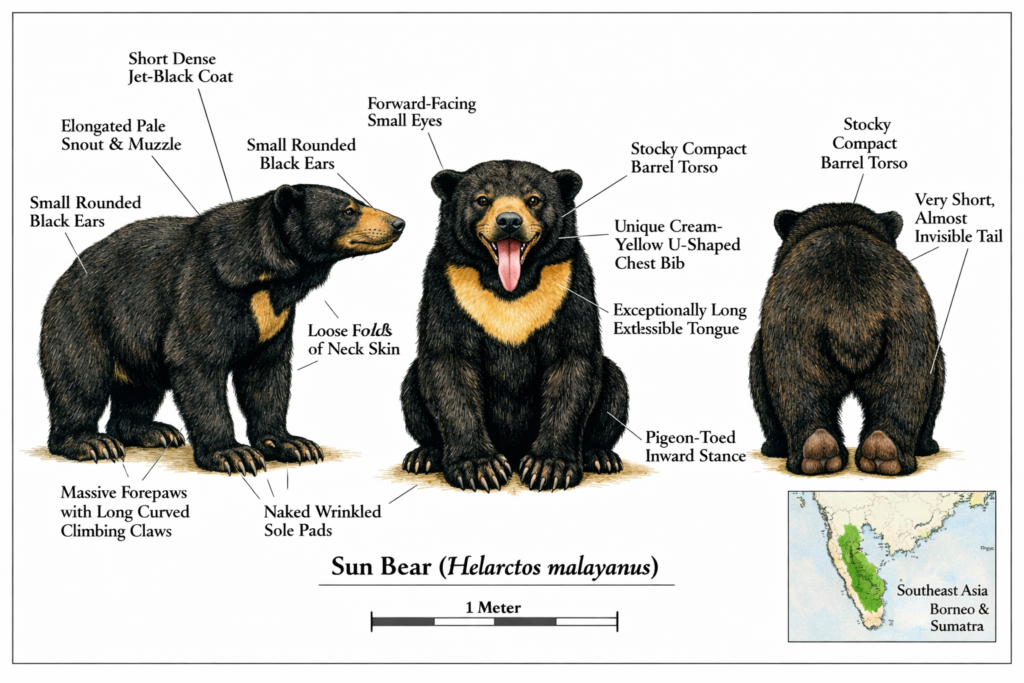
Somewhere in the lowland rainforests of northeastern India–in the green maze of Namdapha, or in the rain-swept remoteness of Mizoram, or in a bit of border forest that flows from Manipur to Myanmar–there is a creature, most Indians have never seen, and would never know they were seeing. It weighs, say, between 25 and 65 kilos, flows through the trees as effortlessly as a weasel, and wears a band of gold across its chest that gleams like a lit match against black.
This is the sun bear, Helarctos malayanus, Earth’s smallest bear, and its most arboreal, its most unknown and (in certain indices, at least) its most silently endangered bear. It has been going down for decades, and globally has shrunk by an estimated 35 percent in 30 years. Less than 10,000 sun bears are estimated to exist throughout its range, from India’s northeastern hills down to the Indonesian islands of Borneo and Sumatra. And in India, a tiny, fringe habitat, so poorly surveyed researchers went for years without quite knowing if there were even bears in certain states at all.
They call the sun bear “the forgotten bear.” It’s a clumsy title, but it’s not wrong. And the price of being forgotten, for a creature so fragile, is played out very gradually and very surely in Asia’s dwindling tropics.
The World’s Smallest Bear
Its range, where it lives and where it has been lost
The historic range of sun bears once described an enormous arc through the tropics of Asia. It extended from northeastern India and Bangladesh through Myanmar, Thailand, Laos, Cambodia, Vietnam, and the Malay Peninsula, and down onto the islands of Sumatra and Borneo. In its entirety this area covered twelve countries and much of the Indo-Malayan biogeographic zone encompassing both mainland and insular Southeast Asia.
That range is now vastly reduced, and often broken, sometimes erased.
The sun bear is now extinct in Singapore. Its status in China, a historical part of whose range lay in the province of Yunnan, is nationally Critically Endangered and effectively unknown in the wild, with assessments in that country ranking it Critically Endangered in the nation, a grade higher than the global Vulnerable ranking. Bangladesh has seen populations that were presumed to be close to disappearing locally. Vietnam and Laos have had widespread disappearances or local declines documented in survey work based on interviews with local residents. Hunters in a wildlife sanctuary in Thailand claimed that populations there declined by more than 40 percent in the twenty-year span from 1984 to 2004 alone.
In India, uncertainty is a cause of despair. Historically, sun bears have occupied tropical rainforest habitats south of the Brahmaputra River in Manipur and Assam and, based on reports, in the northeastern hill country during the 1960s and 70s. By the 1980s and 90s, populations there seemed to have declined such that they were only doubtfully present in much of the historically known habitat. A report by Servheen in 1999 stated there were no sun bears left in India-this was not quite true but was close to a statement of facts at that time.
In the course of surveys undertaken between the 2000s and 2010s, evidence of sun bears was found in Namdapha Tiger Reserve and other areas of Arunachal Pradesh, in Fakim Wildlife Sanctuary and Intanki National Park in Nagaland, in Chandel and Ukhrul Districts of Manipur, and in Mizoram and Dampa Tiger Reserve. In Dampa, a camera trapping study with 647 trap nights recorded only 18 separate pictures of sun bears (trapping index 1.89), which does not mean no sun bears there but indicates thinly spread populations, with occasional regions of presence based on human reporting, interspersed with regions of disappearance.
An Animal Shaped by the Rainforest
The sun bear is not simply an animal that happens to live in tropical rainforests. It is an animal that has been shaped by them over an evolutionary span that stretches back at least five million years, to the divergence of the Helarctos lineage from the ancestor it shares with other bears. It is adapted to the lowland dipterocarp rainforest in ways that run deep — through its morphology, its diet, its reproductive strategy, and its ecological role.
Diet is where the sun bear’s specialization is most visible. It is, officially, an omnivore — and the range of what it eats is genuinely broad: fruits, honey, bee larvae, termites, earthworms, birds’ eggs, small lizards, rodents, and occasionally carrion. But the food sources that most define its ecology and behavior are insects and fruit, and the way it accesses them is what makes the sun bear unique among bears.
The relationship with bees and honey is particularly deep. The sun bear seeks out wild bee colonies in hollow trees and cliff faces with a persistence that seems almost compulsive. Its thick, loose skin — one of its most distinctive physical features — acts as armor against stings, making the bear remarkably tolerant of being attacked by defensive colonies. When it finds a hive, it tears it open with its powerful claws and uses its extraordinary tongue to scoop out honey and larvae simultaneously. The fur around its face is coarse enough to provide some additional protection from stings. The word “honey bear,” which the sun bear is sometimes called, is not casual — it reflects an ecological association that is genuinely tight.
Termites and wood-boring insects are equally important, particularly in lean seasons when fruit is scarce. The sun bear excavates dead logs and rotting stumps with its claws, tearing apart wood that would resist anything but a very determined or very strong animal. This is effortful work, and the sun bear does it constantly, leaving a trail of opened logs and broken stumps across its territory that is one of the most reliable signs of its presence in the forest.
Fruit, when available, can constitute the majority of the sun bear’s diet by volume. It tracks fruiting events across its range and has been documented, in studies conducted in Thailand alongside Asiatic black bears, selecting fruit from the same plant families — particularly the lipid-rich Lauraceae and Fagaceae — sometimes feeding in the same trees as its larger relative. This dietary overlap with the Asiatic black bear has long been noted as a potential source of competitive pressure, though research suggests the two species coexist without clear resource partitioning in some habitats, possibly because food resources are sufficiently abundant in intact forest.
The Bear That Builds the Forest
The one aspect of sun bear ecology that researchers have recently focused on increasingly-and one that should really be much more well-known-is that of the sun bear as a creator of habitat for others.
When a sun bear rips open a hollow tree in pursuit of bee colony or grubs stash, it doesn’t just take food. It expands the hollow. It creates a structure. Over time, these hollows, initiated by rot and beetles but expanded by sun bears, become important nesting and denning sites for hornbills, bats, small civets, flying squirrels and a suite of other cavity-dependent species. This continues to happen where sun bears have been eliminated, but at a slower pace and lower scale.
This makes the sun bear what ecologists term an ‘ecosystem engineer’-an animal that, through its physical actions, creates or modifies habitats utilized by other animals. It is the same sort of a role that the beaver occupies in northern ecosystems and the elephant in the African savanna: a species that, through its presence and behavior, structures the landscape around it, the consequences of which ripple out to benefit a whole host of other species.
The role that the sun bear performs as a seed disperser is no less crucial. The sun bear swallows fruits whole, including the seeds, and deposits them at a distance from the parent tree, at a spatial scale inaccessible to other mechanisms of seed dispersal. Within complex and specialized plant communities, active seed dispersal such as this represents not a mere supplement to the system. Instead, it is fundamental. Studies on the ecological results of removing large frugivores from tropical forest consistently reveal changes in tree species composition and structure that accumulate over generations. The sun bear is a very large frugivore; the elimination of a sun bear from a forest leaves behind a biological debt that is paid out over decades in the currency of shifting vegetation.
The Threats: A Bear Under Siege
The sun bear faces a familiar set of pressures – at least, familiar to any student of tropical wildlife conservation – but the forces that converge upon this species make for a particularly lethal mix.
Habitat loss and deforestation lie at the core of the crisis. The sun bear needs large, intact, lowland tropical rainforest. And that is precisely the ecosystem that has been most severely impacted by human-induced change across the sun bear’s range. In Borneo and Sumatra alone, thousands of square kilometers of rainforest were cleared each year for oil palm and pulpwood production. The relentless growth of the oil palm industry, especially, is wreaking havoc on lowland forest biodiversity, and on this specialized lowland species. Roads opened up forests to further exploitation, and both selective logging (even to remove only large, old trees, important as dens) and industrial forestry (leaving heavily fragmented and simplified secondary forests) have degraded the ecosystem.
The pressures in northeast India are somewhat different but no less significant. Shifting cultivation, agricultural expansion, and construction of roads into remote areas all contributed to habitat loss and fragmentation, with human encroachment into forest edges also expanding settlement in buffers. While these are disturbed forests, subject to human use for generations, the tempo of destruction is increasing.
The second pillar of the crisis is poaching and the wildlife trade. Sun bears are killed and consumed for multiple, disparate reasons, each driving demand in a difficult-to-intercept way.
Bear bile-a digestive fluid stored in the bear’s gallbladder- is used in traditional Asian medicine to treat a variety of ailments including liver conditions, fever and eye problems. This demand is far from fringe, being deeply embedded within centuries of pharmaceutical tradition, and commercially viable within China and Southeast Asia. Wild bears are killed for their bile, which is then processed, dried and sold; alternatively, bears are captured and farmed-confined to bile-farm cages so small they cannot stand, with tubes implanted in their gallbladders that enable collectors to extract their bile almost continuously over years-where it is drained while they are kept alive. Alongside Asiatic black bears and brown bears, the sun bear is one of the three most commonly targeted species for bear bile farms.
India’s Sun Bear: Known yet Unknown.
India’s sun bear occupies a peculiar position in the conservation sphere: it is known to exist, it is protected in law and it is largely unmanaged as a conservation target. The species is listed in Schedule I of India’s 1972 Wildlife (Protection) Act, the strongest level of legal protection available in India and it is listed in Appendix I of CITES. In theory killing and trading in the species is a major offense. In reality, enforcement capacity in the remote forests of northeast India where it occurs is limited, official and community awareness is low and the amount of policy attention granted to the species is practically zero. There is no species specific project in India for the sun bear. There are no species population monitoring programs. The species is documented on state biodiversity surveys and in the wildlife survey work carried out by managers of protected areas, but it is merely an incidental record and not the primary focus of such surveys. Camera-trap images from Namdapha, Dampa or Fakim are proof of presence, not proof of management. It is not entirely the fault of Forest Departments and Wildlife Officials, the Northeast is an enormous and difficult territory to manage, and politics are tricky, and there are dozens of threatened species to deal with. But the lack of status for the sun bear on Indian conservation policy makers agenda is surprising. The only species of bear in India receiving no monitoring, no population assessments, no species-specific action plans. Studies that were conducted – including significant work undertaken by researchers from Wildlife Institute of India and collaborators during the early 2000’s and early 2010’s-had established the species geographic occurrence and identified major threats. They showed a discrete and real occurrence in Arunachal Pradesh, Nagaland, Manipur and Mizoram. They identified human-bear conflict in some areas and development pressure in others through agriculture and slash and burn. And they recommended a list of conservation activities that, more than ten years on, were almost not undertaken. Today the sun bear continues to roam the forests of the Northeast; occasionally photographed, rarely encountered, hardly studied.
Conservation Bright Spots: What is Being Done
It would be disingenuous to write of the sun bear’s dire straits without acknowledging the real conservation effort taking place across its range-efforts providing not only concrete models for working with these bears, but also the grounds for a guarded optimism.
Bornean Sun Bear Conservation Centre-Established by Siew Te Wong in Sabah, Malaysia, this center is arguably the most well-known sun bear conservation effort. The BSCC has established procedures for the rehabilitation of captive-bred sun bears-no small feat, given that bears raised by their mothers are equipped with the necessary knowledge for survival in the wild whereas cubs who never met one are essentially ecolinguistically illiterate-and since 2015, it has been releasing rehabilitated sun bears into protected forests. With a bit of back and forth-a 2025 study published in Wildlife Biology notes that released bears sometimes experience difficulties and even venture into agricultural fields and come into conflict-it appears that this project is learning, adapting, and providing for both the survival of individual bears and contributing to the body of knowledge concerning this species’ behavior.
The ongoing work across the bear’s range through camera-trapping surveys is slowly beginning to gather baseline presence and distribution data; it will take a sustained effort to create a data picture extensive enough to guide any conservation strategy. Work by the IUCN Bear Specialist Group’s Sun Bear Expert Team has been pivotal in coordinating information from across the species’ range and identifying conservation priorities at the range level.
In India, the designation of Namdapha Tiger Reserve in Arunachal Pradesh as a site with confirmed sun bear presence is encouraging, not only is the park one of India’s biodiversity-richest protected areas (spanning almost 2,000 km 2 of contiguous habitat), but it encompasses a significant portion of the bear’s core Indian range, giving it a degree of formal protection. Similarly, other locations with confirmed sun bear presence in India, such as Dampa Tiger Reserve in Mizoram, grant it protection, regardless of the imperfectness of actual enforcement.
What the Next Decade Must Look Like:
The sun bear is struggling in areas where it occurs, but its fate has not yet been sealed. The species still exists in enough areas, enough countries and has enough remaining forest habitat that with the right will, the species could be stabilized and its numbers improved. However, this window of opportunity is not eternal; deforestation continues in Borneo and Sumatra, as do threats from poaching throughout Southeast Asia, and the time to act is narrowing, but not closed. What is needed in India, before any other steps can be taken, is information. A robustly funded, systematic survey of the Indian sun bear’s presence and numbers within northeastern India is the first step upon which all else is dependent. Grids of camera traps throughout the forests where the bear is known to occur (Namdapha, Dampa, Fakim, Intanki and the border forests of Manipur, at a minimum) will complement non-invasive genetic sampling and local interviews to create a snapshot of the Indian sun bear’s situation in a lifetime. This isn’t a monumental expenditure and is the absolute minimum necessary for informed decision making. Improved legal enforcement of existing protections (Schedule I of the Wildlife Protection Act and CITES Appendix I) is also crucial. This requires adequate personnel, equipment, and intelligence gathering networks (specifically regarding wildlife trade corridors through the northeast, as well as neighboring countries such as Myanmar). Community engagement around sun bear habitation sites will need to move beyond the current virtually zero to something concrete and sustainable; these types of efforts, including crop-compensation schemes, diversification opportunities, and meaningful community involvement in surveying efforts, are known conservation techniques requiring political commitment and ongoing funding. Efforts to address global pressures driving sun bear habitat loss, particularly palm oil production, must also occur on both a consumer and regulatory level.
For millions of years, the sun bear has survived in the tropical forests, the best possible place for such a bear to live. Its problem is that it has not, and has not had anything in its history to equip it for, the rate or magnitude of change being forced upon its habitat by human endeavor. The question is not one of survival. The sun bear could be saved. All of the expertise, the necessary tools and even the infrastructure are available. The issue is will we find the willingness to look at this small, gold-chested bear, unseen in the shadowy northeast and south east Asia and declare that it is worth saving. It is. It always was, but we were slow to appreciate it.