
In India lives an animal that virtually no Indians have ever seen, virtually the rest of the world has never heard of, that is being wiped out at a rate that most people tasked with preserving it cannot adequately track. This is an animal that weighs between 10 to 16 pounds, it eats ants and termites, it has no teeth, it has absolutely no interest in any threat beyond an ant mound, and that when it’s threatened, does what it’s been doing for the last 80 million years: it rolls into a ball, enmeshing its body in a shield of interlocking scales so tightly overlapping and precisely articulated it begins to resemble less an animal than an artifact, the scaled, oversized basketball version of a pinecone.
The Indian pangolin (Manis crassicaudata), otherwise known as the thick-tailed pangolin or scaly anteater, is the world’s most trafficked mammal. It is not the world’s most trafficked Indian mammal, nor Asian mammal. The world’s most trafficked mammal, period. Between 2018-2022, at least 1200 pangolins were recovered in illegal trade cases across 24 Indian states. From 2016-2024, the number of pangolins recovered worldwide surpassed 500,000 animals. By law enforcement’s own estimation, recoveries represent less than 10% to 20% of what is taken.
This is an animal that predates our species by millions of years, provides essential ecological services, and is being hunted for body parts of which there is no evidence that they possess medicinal properties, a testament to humanity’s appetite for myth.
An Animal Out of Time
The order Pholidota-the pangolins-dates back about 80 to 85 million years, to the Cretaceous period, when the evolutionary line that was to give rise to the eight present-day species was just diverging from the much more distant ancestor shared with the carnivores. So, it’s not just that the pangolin is old; it is old in a way that scarcely any other mammal alive today is. Dinosaurs were still roaming the earth when the ancestors of the pangolin came into being.
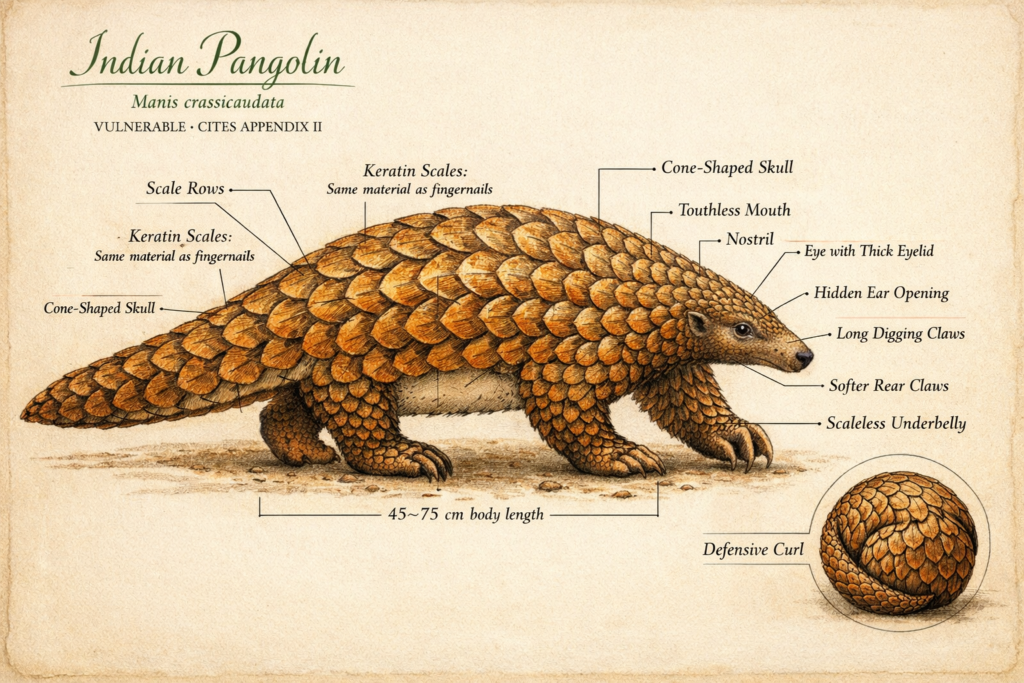
What the pangolin evolved during those millions of years was an almost startlingly specialized body plan. It is the world’s only scaled mammal, and the scales themselves are made of keratin, a protein also found in the fingernails of humans, the horn of rhinos, and the talons of hawks. There are from 280 to 305 individual scales on an Indian pangolin. They lie in 11 to 13 overlapping rows down its back, flanks, and tail and cover the outsides of all four limbs. From a quarter to a third of the body weight of an adult pangolin is composed of these scales. Newly born pangolin babies, which can be born only if the mother has adequate food resources, are born with soft, pale, malleable scales that harden within days. While they are still pliable, they rely completely on their mother’s protection.
An Indian pangolin is from 84 to 122 centimeters (33 to 47 inches) long from its nose to the tip of its tail, a quarter to a third of which is the heavy, thick, whip-like tail that it props against its body when sitting and uses as a rudder when walking. It is that tail that contributes to its ungainly, yet somewhat graceful, waddle; its front claws are so long and so sharp that they cannot be flat on the ground and it walks on its knuckles. These 20-centimeter (8-inch) long claws are the chief instruments of its specialized, yet extremely effective, hunting skills: tearing open termite mounds, digging into hard-packed earth, and splitting into the galleries of wood-boring ants in dead trees.
An adult Indian pangolin may consume between 140 and 200 grams (5 and 7 ounces) of insects each day, translating into over 70 million insects each year-most of them ants and termites that, at this density, would otherwise consume huge amounts of plant roots, trunks, and soil.
Its Habitat, And How.
In addition, what many don’t know is how adaptable the Indian pangolin is compared to many threatened animals. It is not a habitat specialist in the narrow sense that a hangul, or a Nilgiri marten is. It is distributed across the eastern Punjab and Sindh regions of Pakistan across most of India and Bangladesh into northern Burma and southern Yunnan of China and south into Sri Lanka and the Terai region of Nepal.
It has been found from subtropical thorn forest to tropical moist deciduous forest, tropical dry forest to grassland and semi-arid scrubland, and even former forest habitats even after severe degradation. It has a tolerance of altitudes of up to around 750 meters, but prefers lowlands.
Gestation is between 65 and 80 days; the pup can be found riding on the base of the tail of the mother while it walks, and can hide beneath the mother when danger threatens and stays with her for the first few months of its life. The low reproductive rate-one offspring per year at best-is one of the biological realities that make it tragically vulnerable to hunting; the species is simply unable to recover from losses at the scale on which the Indian pangolin is currently being slaughtered.
The trade killing them.
The Pangolin scale is keratin, and this has profound conservation implications. Pangolin scales are, in all ways, identical to human fingernails, and fingernails have no specific properties which render them particularly remarkable compared to other forms of keratin. No modern biochemical or clinical evidence suggests any therapeutic value for pangolin scales at all. None of the proposed active ingredients, if they indeed exist at all, have ever been identified or isolated, and research efforts have been attempting this for many years. None of this has diminished the demand at all.
Pangolin scales have appeared as a therapeutic ingredient in traditional Chinese medicine for over 1,000 years, and are featured in older pharmacological texts in relation to various treatments for promoting blood flow, reducing swellings and most importantly, for stimulating lactation in mothers nursing their babies. The culturally embedded nature of this treatment is very deep; it is not peripheral in any way.
Throughout the early 2020’s, over 200 medical companies in China marketed patented medicines that contained pangolin scales, and over 26,000 KGs were consumed each year in legal trade, providing an incredibly powerful sink for illicit pangolins. Pangolin meat is also served as a luxury dish in some Vietnamese restaurants for affluent customers who use expensive and luxurious items as an integral part of their identity, and pangolins are an important source of bushmeat for consumption in both West and Central Africa. There is also significant pressure on Indian pangolins locally, who are killed and hunted for their meat, scales and skin independently of international markets.
The scale of removals from wild populations are enormous. A CITES report published in early 2026 stated over 500,000 pangolins had been seized globally in the eight years between 2016 and 2024, and in 2019 WWF estimated one pangolin was poached somewhere in the world every 3 minutes. In the decade from 2010-2020 alone, over a million pangolins were taken out of wild populations.
The Geography of Pangolin in India
The most comprehensive picture we have of what Indian trade actually looks like comes from the joint TRAFFIC and WWF-India 2023 analysis, which reviewed seizures reported in the media from 2018 through 2022. The specific numbers are stark.
Across these five years, 1,203 individual pangolins were seized in 342 separate seizure incidents that took place across 24 states and 1 Union Territory. The highest number of seizure incidents and total individuals were in Odisha, making that state the apparent epicenter of trade in this timeframe. The second-highest frequency of incidents were in Madhya Pradesh, followed by a cluster of states in central and southern India. Karnataka emerged as a key source area when considering scale weights (rather than number of individual animals): just 14 Karnataka seizure incidents were linked to an estimated 129 pangolins, indicating industrial-scale collection rather than individual opportunism.
The European Journal of Wildlife Research published a complementary analysis in 2023 of seizures from 1991-2022 that provided a thirty-year perspective on trade trends. That analysis validated the shift in the geography of the trade as Eastern and Southeastern Asian pangolin populations dwindled, and further supported the increasing internationalization of Indian pangolin trade and demonstrated the increasingly direct links between seizure incidents in India and Chinese and Vietnamese markets. A major caveat to both analyses, however, is the poor tracking of information on the origins of seized animals – they are generally not classified by state, origin, by whom caught, or how the animal traveled through the distribution network prior to being seized. Thus, it is difficult if not impossible to identify and intervene against the poaching networks themselves.
Pangolin trade researchers have estimated seizures to be between ten and twenty percent of actual offtake. If true, that would mean between 6,000 and 12,000 individual Indian pangolins may have been trafficked during 2018-2022.
Legal regime and loopholes in India
The Indian pangolin is included in Schedule I of the Wildlife (Protection) Act (amended 2022) – the highest degree of legal protection accorded to any wildlife species under Indian law; same status is afforded to the tiger, elephant, snow leopard, and a number of other key species. The Chinese pangolin that occurs in India’s northeastern states has the same protection. A person dealing with either species – their scales, meat, blood or any other part – would be found guilty and subject to stringent penal sanctions in terms of imprisonment.
India is also party to CITES, and both species were uplisted to Appendix I of CITES – the most restricted international trade classification – in 2016 (CoP17). Appendix I prohibits any form of international commercial trade. Subsequent CITES meetings had also passed numerous resolutions on other measures targeting pangolin trafficking such as increasing the investigation capacity for wildlife crime in general and for the pangolin in particular, sharing of intelligence, and also for developing improved pangolin species identification skills in trade interdiction – since as high as 83 percent of reported trafficked quantities are not reported to the species level making it extremely difficult to know which populations were being depleted at which rate and to what extent.
The nature of wildlife crime investigation itself demands certain expertise that most state forest departments are neither resourced nor equipped to deal with, as it requires the ability to track middlemen, transport networks, end consumers and other aspects of the supply chain. The judicial capacity to deal with wildlife crime also seems limited as wildlife cases often suffer from long pending lists before Indian courts, sentences passed ( when and if they do come through) are generally at the minimum allowed by law, and the overall deterrent effect on organized crime syndicates is weak.
TRAFFIC/WWF’s call for improved law enforcement capacity, enhanced intra-state intelligence sharing, rigorous tracking of pangolin related judicial cases, and community engagement in areas prone to poaching is not new. Such recommendations have repeatedly appeared in prior analyses and reports, and on the whole, appear in prior advocacy documents, and is probably the central problem in Indian pangolin conservation: the gap between recommendation and implementation. The central problem in India, however, is not a gap in knowledge, it is a resource and priority gap.
What Will Actually Work
Demand reduction is the one indispensable intervention. Everything else is necessary, but nothing else alone is sufficient.
While the deletion of pangolin scales from the list of approved drugs in China is a significant step, it affects the drug supply chain without penetrating practice, the black market or the status value that a few cultures attach to pangolin consumption. The sustainable, well-funded, carefully researched behavioral-change campaigns – those with a track record of having had a demonstrably significant impact on consumer demand for shark fin, ivory, and tigers in some areas – that can complement regulatory change are vital. Many organizations, like WildAid and WWF, are making headway in this arena, but this is a slow and protracted business and needs much greater resources than are currently provided.
Law enforcement efficacy will require, at minimum, additional capacity building in India in the form of resources to increase the ranks of those tasked with enforcement, the intelligence capacity of law enforcement agencies, adequate training for those at every level of the enforcement chain, and investment in the entire judicial system process to guarantee prosecutions once individuals are caught. Camera-trap networks in intensive poaching areas and community informant programs in those regions could provide more reliable early warning systems. Standardizing the recording and reporting of all pangolin seizures so that a single database exists that is readily available to researchers would instantly enhance understanding of trade routes and identification of trafficking networks. These are institutional, not scientific, gains and are predicated upon political will.
Community involvement is not optional. In many of the highest-intensity Indian pangolin poaching areas, the individuals who actually perform the killing are not professional wildlife smugglers; they are people from those communities (tribal and marginalized peoples, most often) who are enlisted to do the dirty work and compensated only a fraction of the market value of what they have killed. Stopping this process requires two efforts that are carried out simultaneously: making poaching economically unsustainable in the long term with an enforcement regime that reaches beyond the middle of the supply chain to the individuals committing the kill and providing viable alternative livelihood strategies for the communities at the local level.
Conservation breeding (not commercial farming, but genuine conservation breeding that will be used, for eventual reintroduction) may have a role to play in regions in India where populations have been so diminished. While this is extremely difficult technically and the track record is not a good one, programs like that at Taipei Zoo demonstrate it can be done with sufficient expertise and effort. India has zoological parks and wildlife institutes and expertise in wildlife veterinary care; in principle, a program of dedicated, specialized learning could achieve results there.
And the pangolin simply does not have the public profile it should in India. The tiger has sex appeal, the elephant has affection, even the snow leopard has a mystique all its own that generates widespread public support for its conservation; however, the pangolin’s extremely shy, strictly nocturnal and visually unattractive lifestyle make it unlikely ever to become a focal species of popular awareness. Achieving that public engagement will require the sustained, multi-faceted communication efforts that conservationists and media outlets are not yet making a systematic effort to realize.
80 Million Years of Life
80 million years the pangolin has existed on planet earth. Let the immensity of that register for a moment. 80 million years. Continents have drifted. Seas have receded and returned. The climate has been everything from hothouse to glaciation and back again. The dinosaurs have come and gone. The entire mammalian radiation has taken place. The lineage leading to Homo sapiens first appearing in the last one and a half million years – a blink of an eye at the end of the pangolin’s life story.
The pangolin survived it all. It survived the mass extinction event at the end of the Cretaceous that destroyed three quarters of all life on earth. It survived the glaciations of the Pleistocene epoch repeated ad infinitude. It survived the spread of the early hominins throughout Africa and Asia. It survived the first stone tools, the first fires, the first throwing hunters. It adapted – slowly, yes, but well enough – to whatever challenges nature threw its way.
It has not adapted to this. The speed of the current assault, industrial, organised, and demand-driven, is faster than adaptation. The animal that produces one offspring per year, takes many years to mature sexually, is incapable of running away and quite defenseless against organised human hunters is profoundly vulnerable to what is being done to it. Its ancestral suit of armour is excellent against any threat it was designed to evolve against, but useless against this one.
Somewhere, in the forests, scrub, and agricultural areas of central India-in Odisha, or Madhya Pradesh, or the dry forests of Karnataka, or the grasslands of Gujarat-an Indian pangolin has woken with the dusk, emerges from a burrow which may have been excavated years ago and expanded over the season. And moved tentatively, slowly, toward a termite mound for which its tongue has been evolved over 80 million years to efficiently excavate-exactly as its ancestors did when the last of the dinosaurs still roamed. And doing so, tonight, on a planet that has decreed its scales are more valuable than its existence.
Only we can undo that. Not the pangolin. It will roll into a ball and wait.