
The Himalayan Forest Thrush is a medium-sized thrush, and Turdidae is the family name for thrushes in general-our familiar Indian robin is a member, as are the orange-headed thrush and the North American bluebirds. Globally, thrushes are among the most celebrated songbirds ever, as anyone who knows their complex, musical and carrying songs is aware. The Himalayan Forest Thrush, as we discovered, is true to the family.
Visually, they are good, but not outstanding, looking birds. The top is rich brownish with subtle russet hue, and the underside is much paler, with fine mottles or streaks on the breast and flanks – a standard thrush pattern that in forest light filtering down through leaves creates a dappled effect, but which will seem at a glance to be rather uniform and plain in better light. The bill is fine and slightly down-curved for probing through leaf litter and soil. The legs, relatively shorter than those of the Alpine Thrush with which it was confused until 1998, are the same with tail and wings – built for moving through dense forest, compared with those of the Alpine Thrush which are built for covering more of the alpine slopes with their rough rocks and tussock.
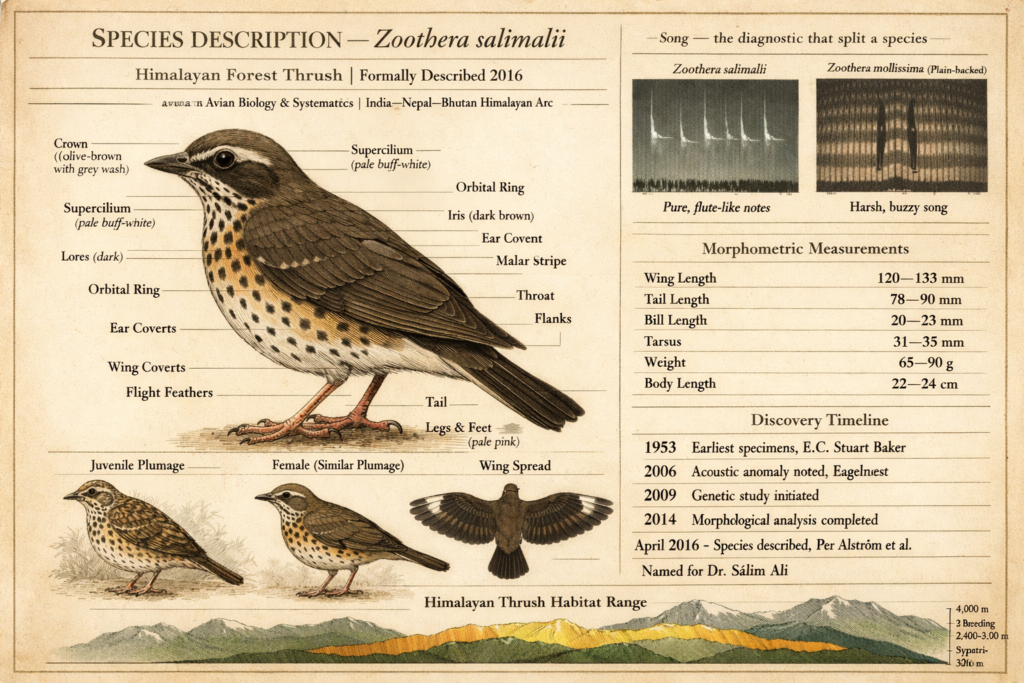
There is no dramatic difference: this is the whole point. As far as visually distinguishing it in the field concerned, you really cannot; the Himalayan Forest Thrush and Alpine Thrush (Zoothera mollissima) appear virtually identical in field sightings. But the differences, though not dramatic, do exist and are measurable in specimens, but they are nothing that would leap out to an ornithologist observing from even a close distance. In technical ornithological terms the two birds are cryptic-distinct species which appear visually similar enough that it’s hard to tell them apart just by looking.
What distinguishes them instantly is sound.
The song that kicked it all off
In May & June of 2009 field worker Shashank Dalvi (Wildlife Biology and Conservation programme, National Centre of Biological Sciences, Bangalore) and experienced ornithologist Prof. Per Alstrm (Uppsala University, Sweden, and world’s foremost expert in taxonomy of Asian birds) were at high altitudes in western Arunachal Pradesh surveying birds across an altitudinal gradient. While they climbed higher and higher up the slopes, from coniferous and mixed forest into open rock-scrub above the treeline of the alpine zone, they heard Plain-backed Thrushes, or at least what they thought were Plain-backed Thrushes, because field guides said that’s what should be there. But something wasn’t right.
The birds in the forest were singing in a way that didn’t quite fit the description of a Plain-backed Thrush. It was a rich, melodic, beautiful song, the kind that makes you stop dead in your tracks. However, those above the treeline on the open rock-scrub were singing something entirely different: harder, raspier, much more unmelodious and raw, a song built to cut across open ground, lacking the resonance and complexity coming from the trees below. Their attention was drawn to the fact that what the field guides said was Plain-backed Thrush sang very melodically in coniferous and mixed forest, whereas in open habitats above treeline in the same region the same thrushes sang in a much more raspier, unmelodious way.
So, you had two songs, more or less at the same altitude, on the same mountain, but one side of the treeline, one on the other. For someone as experienced as Per Alstrm this was not just a curious observation to make and put away for later. It was a hypothesis. Two birds. Two songs. Potentially two species.
Shashank Dalvi recorded the two types of songs and a detailed acoustic analysis was performed which revealed, exactly as the ear suggested, that the two songs were not a result of the variation within the species or even differences in the behaviour of breeding males or non-breeding birds, or the quirks of a single bird’s performance, but a structured and easily distinguishable pattern; the species’ characteristics had been identified correctly by the field descriptions as a Plain-backed Thrush’s song in the case of one of the two singing thrushes but incorrectly for the other in that location. One of Pamela Rasmussen’s colleagues at Michigan State University was asked by the researchers to explain the distinction and they described the difference between the singing of the Himalayan forest thrush and the alpine thrush using the analogy of Adele and Rod Stewart’s singing styles respectively: that one song was controlled, flowing and melodious, while the other was raw and much more built for projection rather than beauty. Of course these are not simply aesthetic considerations but clearly species identifiers for ornithologists.
Seven years, fifteen museums, seven countries
The fieldwork in 2009 marks the beginning of a discovery process that would last a total of seven years. Song was the starting point, but song alone does not suffice for a formal scientific description of a new species. Taxonomy demands the convergence of several independent lines of evidence upon the same conclusion. Alström, Dalvi, Rasmussen and their collaborators – an international group that eventually came to include scientists from Sweden, India, United States, China and Russia – set out to build this case methodologically and across multiple scientific fields concurrently.
The work in the museums was as essential as it was, by Rasmussen’s own admission, surprisingly effective. Museum specimens collected from the Eastern Himalayas over 150 years ago resided in collections around the globe. Skin and skeletal material was examined in 15 different museums spread across 7 countries – including institutions in Great Britain, the United States, Russia, Sweden, China, India, etc. Measurements such as bill length, tarsus length (that segment of the leg that links the foot to the tibia; relative length of this part is ecologically important and depends upon habitat), wing and tail length were all taken; plumage colouration under controlled lighting conditions compared.
“To our utter amazement, specimens held in museums for over 150 years from the same area of the Himalayas proved separable into two groups by morphology,” says Rasmussen. In virtually every aspect, the birds collected from forest habitat had shorter legs and tails, shorter wings and proportionately longer bills than those found in alpine zone habitats. Plumage differences, though more subtle, also proved consistently to be characteristic of each group. Critically, the two forms showed no overlap – there was nothing in between. What appeared as a variable species in the field split into two non-overlapping entities upon dissection of this data.
The third, and most decisive line of evidence came from the extraction of DNA from tissues and older specimens. Using phylogenetic analysis, it was discovered that birds found in the forest and those found in alpine zones branched off the thrush tree at separate times. This divergence happened long ago: “The DNA evidence shows that the two groups had diverged from their last common ancestor at least 3-6 million years ago, and therefore the separation took place during the Pliocene, when the Himalayas were still rising and climate conditions that dictated separate forest and alpine zones were still developing.”
3-6 million years of separate evolution. They have become different species by modern scientific definitions: different songs, different bodies, different life cycles, different roles within the ecology of the range. They have lived side-by-side for this time – at times at the same elevation as each other, as few hundred meters apart in elevation – with no interbreeding, just as cleanly separate as any two geologically sympatric, non-hybridizing species in the world.
The final description was published in the journal Avian Research in January 2016. Its title read: “Integrative taxonomy of the Plain-backed Thrush (Zoothera mollissima) complex (Aves, Turdidae) reveals cryptic species, including a new species.”
The word cryptic species has immense meaning in its context and is central to what this discovery represents: that what is new to science has, and will continue to do so in a world of advancing scientific technology and a rapidly shrinking amount of unexplored areas, existed hidden in plain sight for so very long.
What “cryptic species” means and why it matters
Technically speaking, the Himalayan Forest Thrush is a “cryptic species”-a species that so closely resembles a related species morphologically that typical field identification methods cannot distinguish them. There are more cryptic species around than most people are aware of, especially within taxa that lack clear plumage differences and in which systematic acoustic or genetic analysis has not been applied.
The existence of cryptic species in birds has become evident with increasing frequency as bioacoustics-the scientific study and comparison of birdsong-has come of age as a scientific discipline. Song, in birds, is not merely decorative. Song is, in fact, the chief mechanism for species recognition: it’s how individuals recognize potential mates of the correct species, how they advertize ownership of territory, how they communicate over distances at which visual signals are impossible. In long-isolated species, song reliably and substantially differs from other members of the same genus-often more reliably than plumage does, since song is intimately bound up with breeding and hence under strong selection pressure.
And that, essentially, is why the Himalayan Forest Thrush was sitting, in plain sight, where it did, for 150 years: the taxonomists describing and classifying museum drawer skins used morphology to do the job; they used what they could see on the preserved specimen. They didn’t listen; they could not have listened, since no recording existed. Acoustic identity, the dimension of the species boundary which is most significant for reproductive isolation, simply was not available, skilled as the taxonomists of the 19th and early 20th centuries were in all other respects.
The advent of bioacoustics, however-combined with the ability to make and share good recordings, and with computer-based means of analyzing these recordings in ways that no human ear is capable of-has redefined what we are able to know. The Himalayan Forest Thrush is only one of a number of recent descriptions of new birds which hinge, to a considerable extent, on acoustic data.
The Name: A tribute to the Birdman of India
Scientific name Zoothera salimalii bears with it a certain gravitas that is not to be found with most newly described species names.
Dr Slim Ali-born November 12 1896, Bombay, died June 20 1987-is arguably the most important figure in the history of Indian ornithology, and one of the most significant field ornithologists in the world of the twentieth century. He is widely known, affectionately and accurately, as the “Birdman of India”. In the course of his six-decade career, he systematically catalogued the birds of practically every major area of the Indian subcontinent, producing field-guides and scientific monographs that remain essential reading. He was central to the establishment of bird banding and ringing schemes in India, to training generations of Indian naturalists, and to the institutional development of Indian ornithology through the Bombay Natural History Society, where he worked first as researcher, then honorary secretary, and finally, president.
Slim Ali was a keen conservation advocate; it was largely due to his survey of theBharatpur bird sanctuarythat it eventually received protection, and the wetland loss for migratory birds was one of the earliest scientific voices calling for what is now a standard conservation concern. He received two of India’s highest civil awards, the Padma Bhushan and the Padma Vibhushan, and he was the first non-citizen elected to the fellowship of the American Ornithological Society.
The fact that none of India’s birds was named after him until 2016 seems, in retrospect, to be an omission. The Avian Research paper on this subject puts it right. The species name salimalii -in effect a genitive construction from his surname, as anglicized into scientific form – means literally ‘belonging to Salim Ali.’ It is, in fact, the first Indian bird to carry his name. As it was discovered in India, partly by an Indian co-author (Shashank Dalvi), and adds to ornithological knowledge of an area he spent much of his life documenting, this particular tribute carries with it a sense of directness and fittingness.
It is the first Indian bird to be named in honor of Dr Slim Ali.
The name has significance beyond simple honorific. It has an argument implicit in it about the history and practice of Indian ornithology. A bird discovered more than 150 years ago, housed in museums without anyone recognizing what it was, and now named in 2016 after the man who single handedly helped lay the ground work from which its identity was eventually unveiled: something in that temporal lag says both about how hard the science is, and the long road that still lies ahead.
The bigger story: three species where one was previously believed to exist
The formal description of Zoothera salimalii was not the end of the story but was in fact the start of a wider, ongoing taxonomic review.
The species, which before 2009, was called Plain-backed Thrush (Zoothera mollissima), was distributed across a wide sweep of highlands of Asia including the Himalayas. Alstrm and co did not just split it into two, however; as they collected samples from all parts of the range of the complex and from China, not just north-east India, they found that this complex was more complicated than a simple division into two species.
An analysis of Plumage, structure, song, DNA and ecology of “Plain-backed Thrushes” across their whole range revealed the presence of a third species that, although previously collected, was treated as a subspecies of “Plain-backed Thrush”. Alstrm and colleagues have now given this population its own name: Sichuan Forest Thrush. The song of the Sichuan Forest Thrush was actually found to be more musical than that of Himalayan Forest Thrush.
But they did not stop at three; DNA was obtained from three museum specimens, collected a long time ago and held by museums in collections without anyone being aware of their significance. From the analysis of this DNA, it was revealed that there may even be a fourth species: the Yunnan Thrush, or potentially similar to the Yunnan Thrush. At the time of publication, it had not yet been formally described and further work was needed to ascertain its true status.
The analyses of DNA showed that the three species found, and potentially a fourth, had been reproductively separated for several million years. A complex species had previously been assigned one scientific name. This species was found to actually consist of three separate lineages with different songs, morphologies and ecological niches. This “one” species had really only been seen as one because its classification was based on plumage characteristics and because the population was assumed to be geographically separated rather than reproductively isolated.
This occurrence is not rare within taxonomy; indeed it has become more frequent since molecular techniques began to be applied to “species complexes” that have previously only been described on the basis of their morphology. As soon as researchers start using recordings, DNA analyses and the scientific method of morphometric analysis, they start to find that an “all-encompassing” species is in fact comprised of a number of species.
Where it Lives: The Eastern Himalayan Forest World
The Himalayan Forest Thrush is highly restricted in the type of habitat it occupies: dense coniferous and mixed montane forest between 2400m and 3800m typical elevation, in the eastern Himalayas-breeding range concentrated in the forests of western Arunachal Pradesh, Sikkim and the Darjeeling hills of West Bengal, extending east into southern Tibet and NW Yunnan of China.
This is high-altitude forest, not the tropical jungle of the NE, nor the bare alpine zone of the high peaks. This is the ‘middle’ zone, where the climate is cold enough for conifers to dominate, and the ground covered in leaf litter, rocks in moss, trees hung with epiphytes in the mist. The forests in which the Himalayan Forest Thrush occurs do not have a complex structural arrangement (like a rainforest, where layers vary in diversity) but the ‘complexity’ of this zone consists in abundant undergrowth, plentiful dead wood and a rich soil of soft organic matter containing myriad invertebrates.
This is a resident and altitudinal migrant, so it does not cover vast distances during the course of the year but migrates up and down mountains seasonally. The Himalayan Forest Thrush is present between 2400m and 3800m when breeding, but in winter it descends, recorded at 1450m at least in some sites. This seasonal altitudinal migration strategy is common in mountain-dwelling birds throughout the Himalayas; they track changing resource abundance through seasonal altitudinal migration rather than horizontal migration over the landscape.
It forages on invertebrates-earthworms, beetle larvae, spiders, snails, and fruits and berries when available-in a manner typical of thrushes by systematically searching leaf litter and soft soils. Both leg length (shorter than Alpine Thrush’s) and bill length (proportionally longer than Alpine Thrush’s) can be seen as adaptations: legs that are shorter, and less stocky than those of a bird living more in open habitat, can be beneficial for foraging among vegetation, and a longer bill than those used for extracting items from softer substrates is an adaptation for more efficient foraging from dense ground cover.
The species’ extent of occupancy in India is, based on the State of India’s Birds report, 8,220 sq km in Arunachal Pradesh alone, a measure indicating the relatively small distribution that is suitable, within the topography and climate, for this species. The range is small and patchy, reflecting the patchy distribution of this forest type in a mountain landscape.
It is still there, it is still singing
A June morning, the light filters down in cold, long fingers through a canopy of conifers over 3,000 meters up in the forests of west Arunachal Pradesh. Layers of pine needles and decaying leaves cover the forest floor. The temperature is in the single digits. Somewhere, in the tangle of bushes or the lower branches of a fir, a Himalayan Forest Thrush is doing what this species has always done for anywhere between 3-6 million years: singing.
The song, when it comes, carries through the cold air with the crisp, precise, controlled tone that utterly separates it from the gruff jangle of Alpine Thrush several hundred meters and one hundred feet up above. This isn’t the sound of a singer; it’s the sound of an interlocutor. A communicant-to mate, to rival, to forest-that has always existed here, through the entire span of human history in the Himalayas and millions of years prior.
Humans with notebooks, cameras and binoculars trod these forests for 150 years, heard that song, and described it to posterity as the Plain-backed Thrush. Then, in May 2009, two humans stopped and listened a great deal more attentively than any had ever listened before. And a species that had always been there entered the scientific lexicon: discrete, defined and named.
How many more birds are doing the same thing, in the same forests, this very moment? Is the question the Himalayan Forest Thrush has opened up.