
Wolfs in a factory zone. An unknown cat in the highest peaks of the Himalayas. Leopards found within the concrete sprawl of Delhi. India’s forests are hiding wilder, larger surprises.
In India, something like 35 million photos of wildlife lie on hard drives in forest department offices, university servers and research institutes. Most will not be given the analysis they need. A proportion will be classified as ‘ incidental recordings ‘ – the official term for when the animal photographed was not the intended object of the survey. Some will sit in folders for months before anybody scrolls past the first photo.
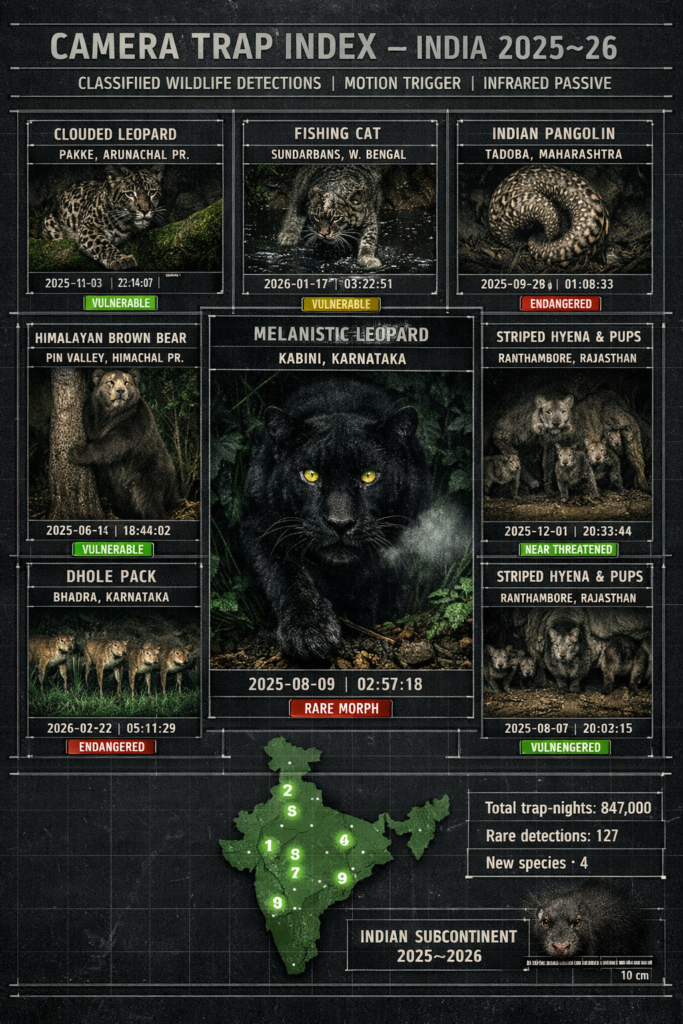
And yet, from this vast, messy, poorly organized torrent of images, a narrative is starting to emerge. A flawed, imperfectly lit, but authentic narrative. India’s wildlife is more dispersed, more adaptable, more astonishing in its persistence and sometimes more abundant than we ever guessed. A camera trap doesn’t lie. A motion sensor fired at 2:47am in a forest block everyone agreed was not worth surveying-this gives you the facts.
An unprecedented flurry of critical camera trap findings occurred in India from mid-2024 to early 2026. New species discoveries in existing reserves, confirmations of animal presence in areas thought to be too degraded for them, estimations of the numbers of animals who were previously essentially uncountably numerous and documented behaviours that field observers had never successfully observed directly; what they represent is something bigger than a collection of facts. They present an argument, that even today and under so much pressure, the country’s wildlife is still uncharted.
This situation is both humbling and urgent. You cannot protect what you have not discovered.
In its simplest form a camera trap is simply a weatherproof camera linked to a passive infrared motion detector. When warm-bodied motion moves through the sensor’s detection field, the camera fires – almost instantly, within fractions of a second – and takes a picture of whatever caused it to trigger. In the right forest at the right time of day, it might be a mouse deer or wild boar. In the right spot, with enough luck, it might be something that nobody in the landscape had seen for generations, or something that nobody had ever photographed alive.
The technology isn’t particularly new. The 2018 All India Tiger Estimation deployed cameras at 26,838 locations across 141 sites and generated nearly 35 million photos, earning the survey a Guinness World Record for the largest camera trap wildlife study. While the survey’s goal was to census tigers and it successfully did, camera traps do not discriminate between their target species and the by-catch; everything that triggers them – leopards, jungle cats, porcupines, golden jackals moving through the trees at three in the morning-gets documented. In addition to providing an estimate of the tiger population the survey produced an invaluable, if accidental, census of India’s carnivore community.
It is what happens after the shutter clicks in 2025 and 2026 that’s truly changed, not so much the cameras themselves. AI-driven tools-CaTRAT, Extract-Compare and various deeper-learning programs specifically trained for Indian fauna-can now sift through tens of thousands of images while it takes a human a couple hundred to identify. Individual animals are identified by unique coat patterns; the striping of a tiger, the spotted fur of a leopard, the specific forehead marking on a snow leopard. The logistical headache of analyzing 35 million photographs has begun to be transformed from a quagmire into something manageable, if not entirely easy.
The discoveries of 2025 and 2026 represent the confluence of three factors: the spread of camera traps into more locations, for longer time periods, and more sophisticated methods of analyzing what the cameras reveal.
Discovery 1: The Snow Leopard Census – a Number that Changed Everything
The most crucial camera trap-based discovery of the 2025 season wasn’t a species first. It was a count – but a count so meticulous, and so far beyond previous estimates, it essentially redefined what was known of India’s most elusive big cat.
SPAI (Snow Leopard Population Assessment of India), a pan-India program coordinated by the Wildlife Institute of India with all snow leopard range states, had released its numbers in January 2024, but publications continued through 2025, detailing the results of India’s snow leopard assessment, totalling 718 across India’s Himalayas.
The Indian estimate was huge. But it was a separate study on the population of snow leopards in Ladakh that was the far more important development.
Published in PLOS One in May 2025, the deep-dive into the Ladakh population, by a team of wildlife protection specialists led by Pankaj Raina of the Department of Wildlife Protection in Ladakh, represented “the most extensive and intensive snow leopard survey ever undertaken in India,” the study stated. Numbers capture the scope: 956 camera traps covering 59,000km² of the trans-Himalayan zone; 6,000km walked by field teams; nearly 10,000 instances of signs of snow leopard presence (scrapes, scent markings, tracks, prey caches) documented; 26,000 images of snow leopards captured over 97,000 trap-nights, each image analyzed using the AI program CaTRAT and pattern-recognition software Extract-Compare. “Individuals were identified based on unique patterns on their forehead rather than those on their side profile, which had been prone to distortion by wind-blown fur,” the report noted, leading to reliable individual identification.
The population estimate derived from the Ladakh data was a startling 477 animals, around 68% of India’s total in one single area, and one of the densest populations of snow leopards ever recorded, with numbers for Hemis National Park being the highest.
A staggering 60%+ of these snow leopards shared their habitat with people- pastoralists, farmers and villages that have lived within the trans-Himalayan landscape for centuries. This disproved the long-held assumption that they could only survive in remoteness and absence from humans. Their survival was dependent on rugged terrain, sufficient prey and low pressure from poaching.
Wildlife Week 2025 saw the launching of SPAI 2.0 by the government to carry forward this initial study into a monitoring framework that will give us a continuous measure rather than extrapolated estimates of snow leopard numbers, and thus assign them to a definite number derived from scientific data.
Discovery 2: Pallas’s cat photographed for the first time in Arunachal Pradesh
WWF-India researchers, working in the western districts of Tawang and West Kameng, installed 136 camera traps at 83 different sites above 4,200 metres between July 2024 and September 2024. Set at 4,200m – 5,000m (13,000 -16,400 ft) altitudes, cameras withstood temperatures well below freezing for a duration of 8 months and recorded, to everyone’s surprise, five species of wild cat; common leopard, clouded leopard, leopard cat and marbled cat, in addition to snow leopard. That these five species occur within the same surveyed area is quite a revelation – a testament to the rich feline communities of the eastern Himalayas- but at 4,200m of altitude? A survey that documented this extent of high-altitude diversity in a single campaign was first among its kind, until a sixth was discovered, adding another incredible dimension to wildlife study in India.
A recent wildlife survey in the Arunachal Pradesh region has brought a cascade of surprising discoveries to light, with one of the most significant being the first-ever photographic evidence of the timid Pallas’s cat within the state.
Pallas’s cat (Otocolobus manul), an incredibly fluffy, flat-faced feline dwelling in the barren steppes and boulder fields of Central Asia, is among the most mysterious wild felines on the planet. This uniquely peculiar looking cat, whose appearance often draws comparisons to a disgruntled permanent expression, owes its dense and elongated coat to the harsh cold of its environment, camouflaging it into near-invisibility amongst the rocks.
Pallas’s cat, the lesser-known among wild cats, is rarely photographed and the sightings of this one in Arunachal Pradesh has widened its geographical range, having previously only been documented in India’s Sikkim state, as well as Bhutan and eastern Nepal.
When WW-India released images of the stocky, round-faced creature shuffling in the snowy, high-altitude environment in September 2025, they instantly captured the world’s attention and created a stir among wildlife researchers; this definitive sighting marks an expansion of its known habitat range and provides key information about its needs and altitudinal boundaries. Researchers are now eager to learn how many other high-altitude locations are yet to be explored to identify if other Pallas’s cats are present.
“The capture of a Pallas’s Cat in Arunachal Pradesh, at almost 5,000 metres, is a strong indication of our ignorance of the life that exists in the Himalayas at high altitudes,” said Rishi Kumar Sharma, head of science and conservation at WWF India’s Himalayas program. “It speaks volumes about the diversity of species such as snow leopard, clouded leopard, marbled cat and Pallas’s cat that coexist within this landscape, and human presence as well.”
Furthermore, the survey recorded a behavioural insight previously undocumented: a snow leopard and a common leopard leaving their scent-marks in the same vicinity, giving researchers an invaluable glimpse into how these two predators coexist and navigate shared territories within the rugged Himalayas.
Discovery 3: Clouded Leopard Preying on a Slow Loris-the First Photograph.
The Dehing Patkai National Park in Assam is already among India’s most outstanding protected areas. The longest expanse of tropical lowland rainforest remaining in India lies within the park borders, and it is the only protected Indian forest where tiger, common leopard, clouded leopard, fishing cat, golden cat, marbled cat, jungle cat and leopard cat have been recorded together, which indicates the species rich wildlife there. This kind of setting makes it unsurprising to record exceptional events from a camera trap. But even in this context, the December 2024 image-published in the Journal of Wildlife Sciences in early 2025-was exceptional. This December 2024 camera trap photo from the Dehing Patkai National Park of Assam of a clouded leopard (Neofelis nebulosa) preying on a Bengal slow loris (Nycticebus bengalensis) is the first of its kind and has been published in the Journal of Wildlife Sciences. The camera trap was installed as part of an initiative between the Wildlife Institute of India and the forest department. Both of the photographed species are of conservation concern: the clouded leopard is listed as Vulnerable in the IUCN Red List, whereas the Bengal slow loris is classified as Endangered and has a rare venomous bite that is capable of causing anaphylactic shock. This first photographic record of a clouded leopard carrying a Bengal slow loris, along a forest trail is invaluable as evidence of this predator-prey dynamic. Later in early 2025, camera traps within the Dehing Patkai National Park also photographed clouded leopards and marbled cats separately within sustained camera trap survey in this dense lowland rainforest further establishing this park as an important center for lowland rainforest carnivores of India whose diversity is still threatened by development at the boundaries.
Discovery 4: 34 Leopards Inside Guwahati City
The results of a camera trap survey conducted between November 2025 and January 2026 did something that wildlife data rarely does in India: it stopped people.
A camera-trap survey conducted between November 2025 and January 2026 has recorded 34 leopards living within Guwahati city, one of India’s fastest-growing urban centres. Researchers also documented a critically endangered clouded leopard and nearly 30 other wildlife species in the forests and hills within and around the city.
Guwahati is not a small town on a forest edge. It is the largest city in northeastern India, a metropolitan area of over a million people, with expanding road networks, construction projects, and the infrastructure pressures of a rapidly growing urban economy. And within its boundaries — in the forested hills that still stand between its spreading neighborhoods — 34 individually documented leopards have established something that is, by any reasonable definition, an urban leopard population.
The clouded leopard documented in the same survey is a species that most wildlife scientists would classify as a deep-forest animal, sensitive to disturbance, unlikely to persist in human-dominated landscapes. Guwahati has apparently not read the literature.
The findings highlight how big cats are adapting to human-dominated landscapes, often living close to settlements and sharing resources such as water sources. Scientists and forest officials say the data could guide mitigation plans as infrastructure projects, including a proposed ring road, expand into wildlife habitats.
The survey also recorded yellow-throated martens, northern pig-tailed macaques, Indian gaur, and at least 29 other wildlife species within the city’s forested hills. The data is not just ecologically remarkable. It is politically urgent: a proposed ring road through some of these forests would cut directly through the wildlife movement corridors the survey has now documented.
Discovery 5: Wolves in South Bengal’s Industrial Belt
For years, local villagers had reported seeing wolves in Purulia district of West Bengal, an area famed more for its mining industry than its wildlife. The reportage, understandably, was dismissed-wolves are not expected wildlife species in industrialised eastern India and the sightings, duly noted, ended up in “unverified” pigeon-holes.
For years it has been just anecdotal evidence that the wolves inhabit south Bengal. The evidence that is presented here now establishes that fact beyond doubt:
It was only after camera traps, set up across the Kotshila-Jhalda forest range in Purulia, had been retrieved and their pictures reviewed in late 2025, that that position was changed. Wolves-Indian wolves, Canis lupus pallipes, a critically endangered wolf species-were present in the industrialized forests of West Bengal. It was the first conclusive photographic evidence that showed wolves existing in south Bengal where such a presence was thought to be improbable.
The importance is twofold: India wolves, an endangered subspecies, have already a restricted and fragmented distribution range in the Indian peninsula. It is imperative that all confirmed populations are listed as conservation priorities. An industrial habitat, where survival of wolves with a significant density of traffic, roads, mines, and people, as most wildlife scientists assume, must be a cause for redefining the notion of habitat suitability.
They were residents, not transient visitors, the photographs spread out over a number of different dates and locations confirmed-they had claimed territory within the region.
Discovery 6: First Photos in Years – Indian Bison Returns to Manipur
In Ukhrul and Kamjong districts of Manipur-the borderland, where hills roll towards Myanmar and humans dwindle along well-trodden foot paths that remain unchanged for generations-an Indian conservation NGO, ENFOGAL,set up camera traps. Their equipment was funded by ideaWild, which provides field supplies for conservationists worldwide. A village that contributed to making this documentation possible: Nongman village. Residents helped identify and select camera sites, scouting terrain and identifying animal trails and watering holes with which they are familiar. Such local knowledge is often irreplaceable for the productive deployment of camera traps, as it will be the best informed prediction about where they might yield results. The camera traps at Nongman village documented Indian bison (Bos gaurus) in Manipur state, an important first. Indian bison-or the gaur Bos gaurus-are the largest wild cattle species in the world. They can be up to 1.8 to 1.9 m (5.9 to 6.2 ft) tall at the shoulder and weigh up to 1,500 kg (3,300 lb). They are not stealthy creatures; yet in Manipur, whose forests are among the most biodiverse in South Asia, no photographic record of the animal existed prior to these camera traps. The implications: India’s eastern forests have more species of conservation significance than current records might suggest-and a community-based camera trapping effort such as the one used here could help bridge that information gap with help from NGOs.
Discovery 7 : An Asiatic Wildcat on the Brink of Gurugram
On January 24th 2026 a camera trap within the Mangar Bani forest-a dwindling patch of Aravalli vegetation clinging precariously to the edge of Gurugram’s urban sprawl, enclosed within roads, construction and the infrastructure of one of the most rapidly expanding urban centers in India-provided an image that was not thought to exist there. The image showed a lone male, hunting after dusk. This was the first record of an Asiatic Wildcat (Felis lybica ornata) in this region. The sighting came about as part of a monitoring scheme that sought to map the movements of wildlife through these fragment forests, however the existence of a wildcat within an environment such as Mangar Bani, is of significant importance; Asiatic wildcats thrive in scrub and dryland, are more adaptable to humans than other carnivores and are more resilient and mobile than the more sedentary Aravalli larger carnivores. It is essential that it survive, for Mangar Bani is of great ecological significance, acting as a nexus between the rest of the Aravallis and the Delhi NCR. This and other species appear to be in far greater numbers here than their sorry appearance might suggest. Other, closely related detections from Mangar during the same period of monitoring have included the first confirmed record of a breeding Rusty spotted cat in this scrubland environment near Faridabad – the furthest north the species has ever been recorded breeding, implying that these fragments at least offer some sanctuary to the carnivores of northern India.
Discovery 8: Sloth Bears return to Purulia
Wolves were not the only discovery made in the forests of Purulia in 2025.
During late 2025 repeated photos of sloth bears were found on camera traps in forests of Purulia. The photographs taken in the Kotshila-Jhalda range and analysed in Nov 2025 showed at least 4 adults compared to one in 2022.
The sloth bear (Melursus ursinus) is listed as Vulnerable on the IUCN Red List; its Indian population has been declining due to loss of habitat and conflict with people. In Purulia, which is not a known bear conservation landscape, the increase in number of individuals in 2025 (4+) compared to 2022 (1) indicates perhaps either recovery or, more likely, expansion from a small resident population always present but not recorded by surveys.
Either way the message is clear – the forest land in the Kotshila-Jhalda range, which does not receive major investment, is not protected as formally, and not primarily managed for wildlife, is capable of supporting two different vulnerable species at the same time. The need for formalization (recognition) of land ownership in Kotshila-Jhalda range before it is developed for other purposes is obvious.
The place of AI in the analysis of India’s camera trap data.
There is no narrative on camera trapping for the 2025-2026 period that can afford not to consider what technologies are revolutionizing researchers’ ability to use this data.
The use of CaTRAT and Extract-Compare for the Ladakh snow leopard survey demonstrate state-of-the-art AI camera trapping in an operational setting. CaTRAT is an animal ID platform that has been tailored to the geography and wildlife of the Himalaya. Extract-Compare conducts pattern recognition, matching individuals by forehead markings over tens of thousands of camera trap images, to compile a list of all known individuals. The Ladakh survey successfully documented 126 unique animals from over 26,000 images with Extract-Compare; hand-cataloging the images would have taken years.
Scientists used an AI-enabled tool called CaTRAT to identify the species captured by the cameras, and then, they used a novel method. They looked at the forehead; the shorter, relatively consistent fur at this location made for an easier and more reliably identifiable canvas than other parts of the body. Just like a fingerprint, individual cats were distinguished by their forehead markings, which were digitally recorded using an ML program called Extract-Compare. In this study, 126 individual cats were identified. This also resulted in India’s first national photographic library of snow leopards, an organized record of individual ghosts that allows researchers to follow individual snow leopards over several years and borders.
Establishing India’s first national snow leopard photo-library is just a step forward; it creates an infrastructure for longitudinal monitoring. Individuals can now be followed from year to year, their movements can be mapped, their reproduction monitored, and mortality event detected. This type of infrastructure has been the basis of tiger conservation in India for decades, and now snow leopards will also benefit from this technological support.
The AI methods being utilized for snow leopard ID are being tested on other species as well. Data from Indian tiger camera trapping studies is being re-analyzed through deep learning systems that can identify and record non-target species such as tigers, wild dogs, sloth bears, and other small carnivores within tiger surveys. The vast amounts of data collected in India over the last decade, that up until now has gone largely unanalyzed for anything other than its targeted species, is being unlocked by AI.
So what does the Camera Trap record tell us about India’s forests?
Taken together, the discoveries of 2025 and 2026 confirm several observations that go beyond any one finding. First: India’s forests are under-surveyed. Pallas’s cat had presumably been in the high Himalayas of Arunachal before 2024; wolves in Purulia before 2025; and gaur in Manipur’s eastern hills before the ENFOGAL cameras went up. The records are new, but the animals are not. The gap between the animals that exist in India and those that science knows to be in India is enormous, and is due to lack of surveys rather than rarity. Second: Wildlife exists and thrives in fragmented and degraded habitats. Wildcats in the patch of the Aravalli near Gurugram’s periphery, Mangar Bani; wolves and sloth bears in the industrial periphery of Purulia; 34 leopards in Guwahati’s urban hills. The findings suggest that pristine, protected wilderness is not the only, or indeed perhaps even the main, site of conservation value; fragments on the fringes, which have never been deemed worthy of formal protection, harbor wildlife and deserve protection because they do. Third: AI is a game-changer. The combination of extensive field surveys and AI-driven data analysis that produced the Ladakh snow leopard survey’s population estimates offers greater accuracy than ever before possible. As such tools become more affordable and more widely accessible, so will the ability to generate quality wildlife population data; an ability which will be hugely beneficial for species which lack the charisma to garner the attention that tigers receive. Fourth: Camera traps reveal behaviors which are difficult or impossible for a human observer to witness. An interaction where a clouded leopard preys on a slow loris; two common leopards sharing the same scent marking spot; those observations can only be made by a camera that is always there.
Discoveries that have not yet been made
The most important aspect of the 2025-2026 camera trap season isn’t what it has documented, but rather what the records indicate about what remains undocumented. What else remains undetected in the high Himalayas if a Pallas’s cat was only officially confirmed in Arunachal in 2025? What other populations of wolves remain undiscovered in industrial landscapes whose lack of survey was not considered worthwhile? How many other populations of the 34 leopards discovered in the urban hills of Guwahati are out there, in the forested hills surrounding other northeastern cities, that have never had a camera trap grid deployed across them? Camera trapping is regarded as one of the most effective methods for tracking elusive species without direct observation, and it is via this technique that melanistic tigers have been found in Simlipal, smooth-coated otters in Nandhaur Wildlife Sanctuary, and the Asiatic Caracal recorded in Jaisalmer, amongst many other species. Camera trapping in India has so far mostly been confined to India’s tiger reserves and wildlife sanctuaries where a presence of wildlife has already been presumed. The Discoveries of 2025-2026 have consistently come from areas outside or bordering the established protection network, and the data suggest that systematic deployment of camera traps across landscapes currently excluded from the network – degraded scrub lands, industrial peripheral forest fragments, urban forest patches, and community forests – could substantially expand knowledge of wildlife distribution within India. Such investment, of camera equipment, field time, community engagement, and AI analysis, need not be extravagant. The 2018 tiger survey cost approx 200 crore Rupees. A national camera trap survey of the entire Indian forest cover outside protected areas would likely cost more. But the dividend in knowledge, priorities for conservation, and the identification of undervalued areas needing protection would be enormous.
A forest that still surprises us:
When a camera trap produces an image we didn’t anticipate, there’s a peculiar phenomenon at play. It’s not quite like the shock of a field researcher discovering an elusive creature, the blend of individual quest and the confluence of luck and skill. Camera trap pictures are less effervescent. They are evidence, recorded in the absence of the observer, while the woods carried on unobserved. The creature crossed the light beam. The shutter triggered. Weeks later, someone sifted through the images.
That moment of scrolling – when the blurred infrared pixelated image resolves into a Pallas’s cat at an altitude of 16,000 ft, or a wolf in a habitat where wolves had been thought extirpated, or a bewildering thirty-four leopards wandering a metropolitan district – is not a personal triumph. Instead, it’s a correction. A correction by the forest itself to our limited understanding of what resides within its bounds. A rebuke from the landscape to the mental models we harbor concerning what is extant and where.
India’s forests are largely uncatalogued. This does not refer to lack of mapped boundaries, but lack of knowledge of their inhabitants – their numbers, the connectivity between their communities, their susceptibility to the changes occurring in their vicinity, data crucial for conservation efforts. The camera trap catalog compiled between 2025 and 2026 is not the definitive account, but a demonstration of a more complex and extensive reality.
The cameras remain functional. The motion sensors are actively monitoring in remote high passes in Arunachal Pradesh, on the periphery of Gurugram’s residual woodlands, and on the arid slopes of the Purulia hills, areas in which no wolf had been predicted to exist. Whatever will pass through the light beam in the future will serve as a further correction, revealing yet another truth the forest has kept hidden until our eyes fell upon it.