
As big as a large squirrel. As agile as a leopard. And virtually nobody knew it was there.
Highlights at a Glance:
- The rusty spotted cat (Prionailurus rubiginosus) is the world’s smallest wild cat and weighs only between 1 kg and 1.6 kg.
- The cat is only found in the Indian subcontinent, inhabiting areas in India, Sri Lanka and Nepal – nowhere else on earth.
- The rusty spotted cat is currently listed as Near Threatened on the IUCN Red List and its population has been estimated to be in decline.
- The entire world wild population of mature rusty spotted cats is estimated to be under 10,000 individuals.
- The species is severely threatened by deforestation and habitat loss, agricultural encroachment, retaliatory killing and the illegal pet trade.
- It is protected by law under the Wildlife Protection Act of India 1972, where it is listed under Schedule I, and it is also CITES Appendix I listed.
- The rusty spotted cat is considered one of the least-studied wild cats in the world.
- In recent times breeding populations have been documented in Maharashtra (2023), Aravalli scrublands near Delhi (2026), and in Kanha Tiger Reserve.
There is a cat in India which most people confuse with a kitten. The animal, which possesses a frame like an 8-week-old domestic kitten, a coat which resembles that of a clouded leopard in miniature and large, disproportionately placed eyes making it seem that the creature was not designed for any specific purpose than its sheer appearance, has been verified as a fully adult creature and an apex predator. Adults can reach a size between 1 to 1.5 kg (about the weight of a bag of rice) and can stretch from their nose to the base of their tail between 35cm and 48cm, with a tail measuring from 15cm to 30cm in length making them about as long as a school ruler. Despite their small size, they are not immature, hybridized creatures; rather the completely evolved wild cats known as the rusty spotted cat (Prionailurus rubiginosus), the world’s smallest wild cat. In the arid deciduous woodlands of the Indian states of Maharashtra and Madhya Pradesh, as well as the dry grasslands of Gujarat, the rocky scrub of Rajasthan, and more recently confirmed in the Aravalli hills, north of Delhi, this petite creature continues to lead its secret, nocturnal and almost undocumented existence within an increasingly fragile and disappearing habitat.
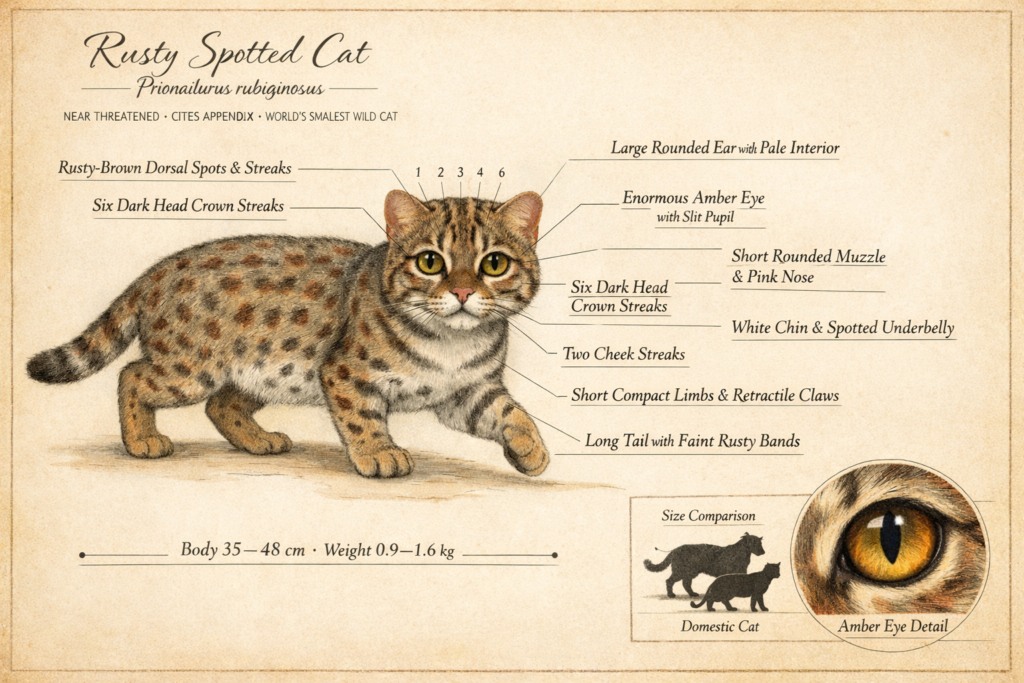
The Rusty Spotted Cat. The rusty spotted cat is placed in the genus Prionailurus, of which the leopard cat and fishing cat, are also a member. Prionailurus is a genus which diverged from the common ancestor of all cats approximately 6.5 to 8 million years ago in the Miocene, thus being one of the oldest lineages of cats remaining.
Three subspecies are currently recognised; Prionailurus r. Rubiginosus found in India and Nepal, P.r. Phillipsi found in the wet forest zone of Sri Lanka and P. R. Koladivius found in the dry lowland zone of Sri Lanka. The Indian subspecies comprise the largest percentage of the worldwide population. India has the largest share of the overall cat population.
Size, Weight, and Physical Facts
The Rusty Spotted Cat –
| Feature | Detail |
|---|---|
| Scientific Name | Prionailurus rubiginosus |
| Common Name | Rusty Spotted Cat / Scaly Anteater of cats |
| Body Length | 35–48 cm |
| Tail Length | 15–30 cm |
| Weight | 1.0–1.6 kg (males slightly heavier) |
| Lifespan (wild) | Estimated 4–7 years |
| Lifespan (captivity) | Up to 14 years |
| IUCN Status | Near Threatened (declining) |
| Legal Protection (India) | Schedule I, Wildlife Protection Act |
| CITES | Appendix I |
| Subspecies | 3 |
| Countries | India, Sri Lanka, Nepal |
| Gestation | 65–70 days |
| Litter Size | 1–2 kittens |
Of all of the world’s wild cats, the rusty-spotted cat is in every measurable aspect the smallest of them all. Though the black-footed cat of southern Africa sometimes competes for the title in informal literature, when body weight is compared the rusty-spotted cat is always the winner with adult females tipping the scales at just 900g (2lbs)! An adult of the species weights only about 1.5kg (3.3lbs) with a body length of 35-48cm (13.8-18.9in) – only about half the length of an average domestic cat.
Like all cats its claws are retractable and the dental formula is the typical felid (four canines, numerous premolars and the definitive carnassial shear) giving the family a powerful hunting profile. Exactly the same profile as a tiger, but at scale 1/200th, and targeting similarly scaled prey: insects, frogs, lizards, rodents, small birds and, sometimes to the dismay of the region’s farmers, domestic chickens.
Where is the Rusty-spotted Cat in India?
The geographical range in India of the rusty-spotted cat is larger than most imagine and is beginning to be understood better through the growth of camera trapping and citizen science programs. It has been confirmed across an arc of the Indian subcontinent; dry deciduous forests and scrub of central India (Madhya Pradesh, Maharashtra, Chhattisgarh), along the Western Ghats corridor from Karnataka down to Kerala, dry forests and grassland in Gujarat (including Gir), in Odisha, Rajasthan, and in the Terai grassland of Uttar Pradesh. The northern most record of sighting for the species has been in the Pilibhit forest division, of the Indian Terai in Uttar Pradesh.
A milestone for Indian conservationists, the first peer reviewed record of a breeding population of the rusty-spotted cat were published in Aravalli Scrubland near Faridabad, Delhi-NCR – the most northerly confirmed breeding record of the world’s smallest wild cat. Researchers from Indira Gandhi University, Haryana found a breeding population at this site. The camera trapping work carried out in Kanha Tiger Reserve-a rarity in systematic research on this species in central India-confirmed consistent use of dense-canopied forest and steep topography and sporadic captures near agricultural buffer zone areas.
An estimation of population densities has been recorded at Gir Protected area in Gujarat as 6.67 individuals per 100km2. Also unexpectedly this species has been confirmed to inhabit alternative locations, through studies in of abandoned gold mines in the Kappatagudda Wildlife Sanctuary, Karnataka which showed the involvement of the rusty-spotted cat in creating a semi-natural sub-terrestrial environment, while records in the eastern Gujarat forests showed cats denning in caves and between boulder clusters.
Preferred Habitats
The rusty spotted cat occupies several types of habitats, and this adaptability has meant that they still exist in some intensively managed landscapes where specialized cats no longer do. The adaptability has its limits.
Habitat loss and deforestation are the primary threat to rusty spotted cats due to agricultural clearance and irrigated agriculture on a vast scale, or conversion to urban and industrial uses and mining. The habitat preferences of dry deciduous forest, rocky outcrops, thick scrub and long grass align closely to those habitat types most likely to be removed as part of India’s developmental agenda; solar parks, highway expansion projects, mine operations are all landing with a particular impact in the core dry western and central Indian habitat areas.
In forest habitats at Kanha, the cat was found to prefer dense canopy and rugged relief (those areas that were structurally diverse and provided a good prey population). In the open habitat of Gujarat grasslands and scrublands the cat was observed using rocky outcrops or vegetation patches for cover whilst hunting in the open at night.
A pertinent (and important) unanswered question is whether the colonies that exist in agricultural margins and other altered human landscapes are actually an example of species co-existence or just last individuals remaining in degraded habitat making use of what is available. Despite records of rusty spotted cat within agricultural land and settlements, it is not clear if the species can survive long-term in agricultural landscapes. This question is not academic; the answer determines whether the current species distribution indicates resilience, or whether it is a statement of remaining habitat.
Diet and Hunting Behavior
The rusty spotted cat is a dedicated carnivore and its predatory ability (on a proportional basis) must be every bit as impressive as that of any big cat. Its hunting is mainly at night because most of its prey (small mammals, frogs, small lizards, ground nesting birds and large insects) are most active at that time.
Its mode of hunting is an ambush. It will stalk through dense vegetation at a sedate pace, its large eyes enabling it to see movement in the gloom, then it will launch itself in a manner quite startling to observe. Diet in Sanjay Gandhi National Park was measured to include small mammals and birds in the majority of instances and invertebrate matter in secondary.
Studies in Karnataka proved the bat to also be a food source and the body of a dead rusty spotted cat was discovered to contain a whole partially digested bat. Primarily a ground hunter, the rusty spotted cat is an adept climber and uses trees to escape predators (mainly larger carnivores sharing the same habitat), or to survey its surroundings. It is able to use the vegetation, like the larger cats cannot due to size limitations, with immense fluidity making it a successful hunter of small animals that utilize cover. The prey items that it takes is important from a purely ecological perspective. By reducing populations of rodents, small birds, and frogs, the rusty spotted cat performs the same function as its larger counterparts in controlling rodent pests, to farmers this has value.
Population Status and Trends
Population Status Summary
Research coverage: Critically inadequate — most distribution data comes from opportunistic camera trap records rather than systematic surveys
Global wild population: Fewer than 10,000 mature individuals (IUCN estimate)
Trend: Declining
IUCN Category: Near Threatened (2016 assessment, under review)
Distribution: Fragmented and becoming more so .
The Biggest Threats Facing the Rusty-Spotted Cat
Habitat Loss and Degradation
This is the ultimate cause and the threat which impacts the entire species range equally. India’s dry deciduous forests – where the rusty-spotted cat is found – is one of the most converted types of forest. Land has been converted to agriculture, mining and infrastructure, or is being covered in rapidly developing solar installations across the Indian heartland. Habitat loss is at a pace with which the species, with a long time between reproductive generations and a low number of kittens per litter, is simply unable to cope.
Just as harmful as outright habitat loss is fragmentation. As habitat patch size shrinks, isolated patches support ever-smaller populations that cannot access resources or mate beyond their individual patches, leading to the breakdown of the genetic network. Small home range and poor reproductive success make a fragmented species on a death spiral.
2. Agricultural Expansion and Irrigation Schemes
The conversion of dry scrublands and sparse forests into intensely cultivated areas dependent on intensive irrigation eliminates the necessary vegetation cover and prey community for the species. Cotton, soybean and sugarcane farming, which have taken over vast tracts of dry landscapes in Madhya Pradesh, Maharashtra and Rajasthan, are now a direct cause of habitat loss.
3.Retaliatory Killing
Local rural communities have, on occasion, mistakenly identified a rusty spotted cat as a young leopard, triggering fear, and subsequently killing the animal. The implications of this mistaken identity is critical as it results in the unnecessary death of an animal that represents a negligible threat to human beings, and a very limited one at that to creatures larger than a chicken.
Poultry predation is a reality and an undeniable cause of conflict, however. Small, spotted and of a mass not exceeding 1.3kg, the rusty-spotted cat can easily prey on chickens in uncontained coops. The loss of even one chicken can be a severe blow to a poor rural family. Killing the animal and trapping are not unreasonable, though, ultimately destructive, reactions to these incidents, and cats taken from domestic prey have been known to be killed in response. Some areas see illegal killing for consumption of their meat and the hunting of the cats as a consequence of predation on poultry.
4.The Illegal Pet Trade
With such an unusual and small size and distinctive coloring and marking, the exotic pet trade has developed an intense and focused desire for a captive, domesticated form of this beautiful wild creature. Kittens are sometimes captured and taken by these traders where they are ultimately offered for sale on online illegal animal trade platforms; sites that are, because of the size of the net, difficult to fully police. Any of the animals that are acquired from this illegal pet trade that manage to survive the journey from where they were captured to the point of sale, will typically be killed by the stress of captivity within weeks.
5.The Fur Trade
The fur trade is not as prevalent as some of the aforementioned dangers but still exists as a threat to the species. There are still occasional sales of fur and there is always a demand for the cat’s fur which has the characteristic spots and distinctive markings, but not enough to have a devastating impact. As the species has a population numbering less than ten thousand world wide any death from the fur trade is one that contributes non-trivially to overall mortality rates.
6.Expansion of the Solar Energy sector
A largely overlooked, but increasingly significant, threat is the rapid development of solar energy plants in areas of the central Indian landscape that also contain habitat for the rusty-spotted cat. Despite being sparse, the arid scrubland of Rajasthan, Gujarat and Madhya Pradesh provide habitat to substantial rusty-spotted cat populations and the conversion of large tracts of land for solar installation permanently transforms the landscape for ever on ecological timescales.
7.Roads and Vehicular Collisions
Roadkill rates for the rusty-spotted cat are largely under-reported, but road mortality can increase at an alarming rate given the fact that the animal is nocturnal, and small, fast-moving species have relatively little chance of avoiding headlights at night. The construction of new roads across India’s central forest landscapes, several of which traverse rusty-spotted cat territory, represents an increasingly potent threat which has thus far received very little research.
Conservation Initiatives: Where Efforts are being made
Although there are some significant structural shortcomings, real conservation efforts are in progress and recent years have yielded some positive advancements.
Citizen science projects have yielded positive and fruitful results; the Small Cats initiative at Sanjay Gandhi National Park, led by researcher Shomita Mukherjee of the IUCN Cat Specialist Group, involved citizen volunteers in both camera trapping and feeding analysis. These efforts, largely community-powered data collection, led to the production of peer reviewed publications. A 2024 study assessed the feeding ecology of the rusty-spotted cat and other sympatric small carnivores in Sanjay Gandhi National Park and neighboring human-dominated areas.
Breeding records have been found at locations in Maharashtra (Satara district 2023), Aravalli scrublands near Delhi (2026), multiple locations in Karnataka and Gujarat, showing that this species is breeding in a greater diversity of habitats than previously realized and is widespread. Each record of reproduction is important as this is a species with a global population of fewer than 10,000 individuals.
Camera trap grids set up in tiger reserves to assess tiger populations and, subsequently, leopards, have been serendipitously recording rusty-spotted cat sightings. Kanha Tiger Reserve produced some of the best available data on habitat use by this species through its methodical camera trap grid. The problem lies in the fact that most of these sightings and records are unanalyzed; the data is buried on hard drives, as nobody is adequately funded to go through and document it.
The 2025 systematic review published in Mammal Research, representing 70 research papers, 20 conservation projects and 121 occurrence records, is one of the first true pieces of evidence to guide future research and conservation priorities. It calls for studies on the genetics and disease ecology of this species as well as its reaction to habitat change, rather than simply gathering more distribution records.
What should be done
Rusty spotted cat conservation does not need its own mega-project with its own bureaucracy. It needs to be included-in existing processes, existing structures, existing conservation machinery. Protected area management plans must formally identify and address rusty spotted cat presence; forest clearance impact studies for dry forest and scrubland must make the species’ needs a consideration rather than just assuming only tigers and elephants exist; solar site selection criteria must stipulate detection of small carnivores, not only the larger ones.
Villager education in rusty spotted cat areas needs to include cheap and effective methods of deterring poultry predation, such as better coop design and compensation systems, which remove the profit incentive for killing the cat; training to differentiate it from a leopard cub would prevent the senseless deaths from misidentification which currently occur. Small grant funding (small by conservation biology standards) for research that specifically fills the knowledge gaps that the 2025 systematic review has revealed, will allow informed decisions based on evidence. Rusty spotted cat does not need a highly technologically intensive or expensive study; it needs careful attention over time by funded scientists.
Broadly, India’s conservation needs to recognize that there are dozens of species apart from megafauna-small cats, civets, hedgehogs, small carnivores of all stripe and scale-which fulfill ecologically important roles and are on the decline and for whom no systematic attention is paid because they do not happen to be tigers.
So is there hope for the Rusty Spotted Cat?
Not so much on the edge of the world as the Amur leopard or Sumatran rhinoceros. Its status on the IUCN Red List is merely Near Threatened and not Endangered or Critically Endangered, for the simple reason that it can be found in such a large range and does seem to be able to persist in modified habitat, to some extent.
But Near Threatened and declining with an adult population less than 10,000 and fragmented habitat is not the most stable situation to be in. It’s a place where populations can slide downhill quite quickly when the rate of habitat change speeds up, when the information isn’t available soon enough to stop the population slide and when infrastructure is not designed for the animal.
It’s both illegal to hunt the rusty spotted cat in India and Sri Lanka. Conservationists recognize the necessity to protect the habitat, and undertake additional study, in order to protect this miniature hunter in the wild.
The really positive news here is that it isn’t necessary to begin an entirely separate conservation policy for the rusty spotted cat; it simply requires that the species be taken into consideration. Habitats crucial to the rusty spotted cat, including dry deciduous forest, scrub-land with rocks, and tall grasslands, overlap to a great degree with the habitats managed for larger, more well-studied carnivores. It isn’t necessary to build separate infrastructures to accommodate the rusty spotted cat; a well-managed tiger or leopard sanctuary can serve to accommodate and provide prey for it simultaneously.
The need for this species comes in giving it more attention. Most humans have never seen a rusty spotted cat, as they are incredibly shy; that is, to a certain extent, part of the problem. But “seen” here has a more important meaning. It implies acknowledgement, acceptance of the fact that it is a part of India’s wildlife heritage, and that it warrants protection and study.
The rusty spotted cat, about the size of a squirrel, is one of the most incredible species to be encountered. It’s only flaw is that most individuals who live near it are completely unaware of its existence, and this isn’t simply an opportunity lost for awe; it’s also a conservation problem with a clear and easy solution: a greater awareness.